
July 31, 2026
Acumatica Cloud ERP for Retail Commerce: Key Benefits from C&A Technology
TL;DR
Acumatica Cloud ERP for retail commerce replaces disconnected point-of-sale, eCommerce, warehouse, and financial systems with one connected platform built for retailers of every size. Acumatica Cloud ERP adoption has already helped many organizations eliminate the data silos that used to separate the storefront from the stockroom, while legacy, single-channel systems increasingly can't keep pace with real-time inventory, personalization, and omnichannel expectations.
This blog breaks down the advantages, the implementation path, and how C&A Technology delivers them.
Let's talk about Acumatica Cloud ERP Built for Retail Commerce
The Key Impact of Acumatica Cloud ERP for Retail Commerce: A Guide from C&A Technology
Retailers today live or die by whether their channels tell the same story. A shopper who checks stock online, then finds a different reality at the register, or places a BOPIS order that isn't actually waiting at pickup, doesn't blame the channel; they blame the retailer. 67% of BOPIS customers make an additional purchase during pickup, but that upside only shows up when the inventory behind the promise is accurate, one visible example of a much broader problem: omnichannel only works when every channel is reading from the same real-time data.
Acumatica Cloud ERP for retailers is a unified, browser-based platform that connects inventory, point of sale, eCommerce, purchasing, customer data, and financials into a single source of truth, replacing the patchwork of disconnected systems most retailers have relied on for years. It gives every team, from the sales floor to finance, the same real-time data at the same moment.
That matters right now because pressure is compounding from every direction: shoppers expect a "phygital" experience where in-store, online, and mobile all draw from the same account and inventory; margins are squeezed by markdowns, returns, and stockouts; and leadership is being asked to adopt AI-driven forecasting without adding headcount. Legacy retail systems, built for a single-channel era, were never designed to carry that load.
Beyond Retail Commerce: One Connected Acumatica Platform for Retail Commerce, Discrete Manufacturing, and B2B Distribution
A shopper doesn't care which system rang up their purchase. They expect the same price, the same loyalty balance, and the same stock count whether they're standing at the register, browsing on their phone, or picking up a BOPIS order at the counter. Acumatica Cloud ERP is built to make that true behind the scenes, and retail is one piece of a platform that also runs manufacturing, distribution, and B2B selling for retailers who source, assemble, or wholesale alongside their storefront.
C&A Technology implements that same platform across all three. A retailer that also sells wholesale to other businesses, a distributor that operates its own retail storefront, and a manufacturer that sells direct-to-consumer are all configuring the same Acumatica foundation around different customer-facing workflows. What stays constant is the data: inventory, pricing, and the customer record are visible end-to-end, with AI, personalization, demand forecasting, anomaly detection, working across every channel instead of living inside a single POS or storefront tool.
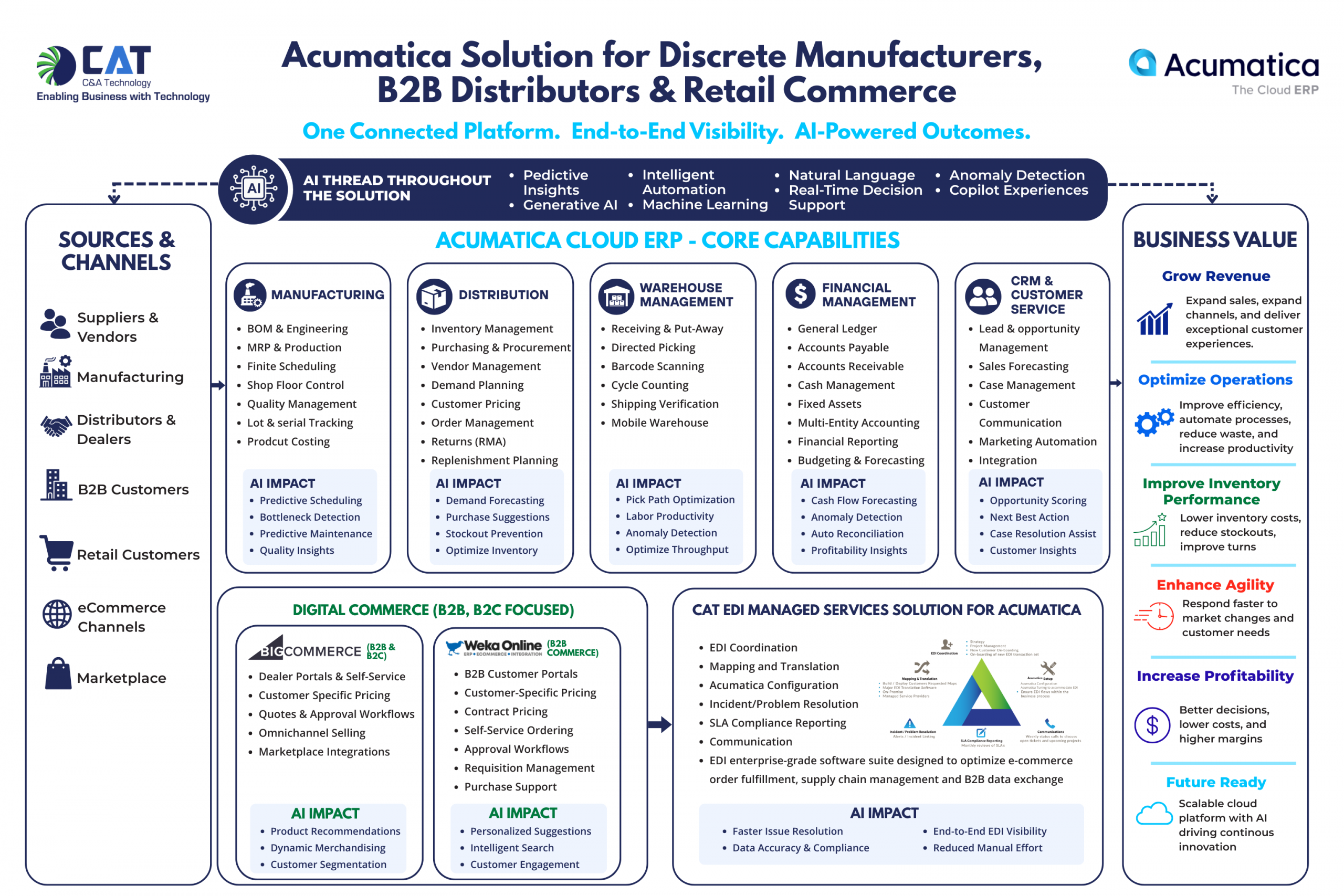
The framework below shows how that comes together: Acumatica's Core Capabilities, Digital Commerce, and CAT's EDI Managed Services operating as one connected system, feeding directly into the outcomes that matter most for a retailer, revenue growth, tighter inventory accuracy, and the agility to keep every channel telling the shopper the same story.
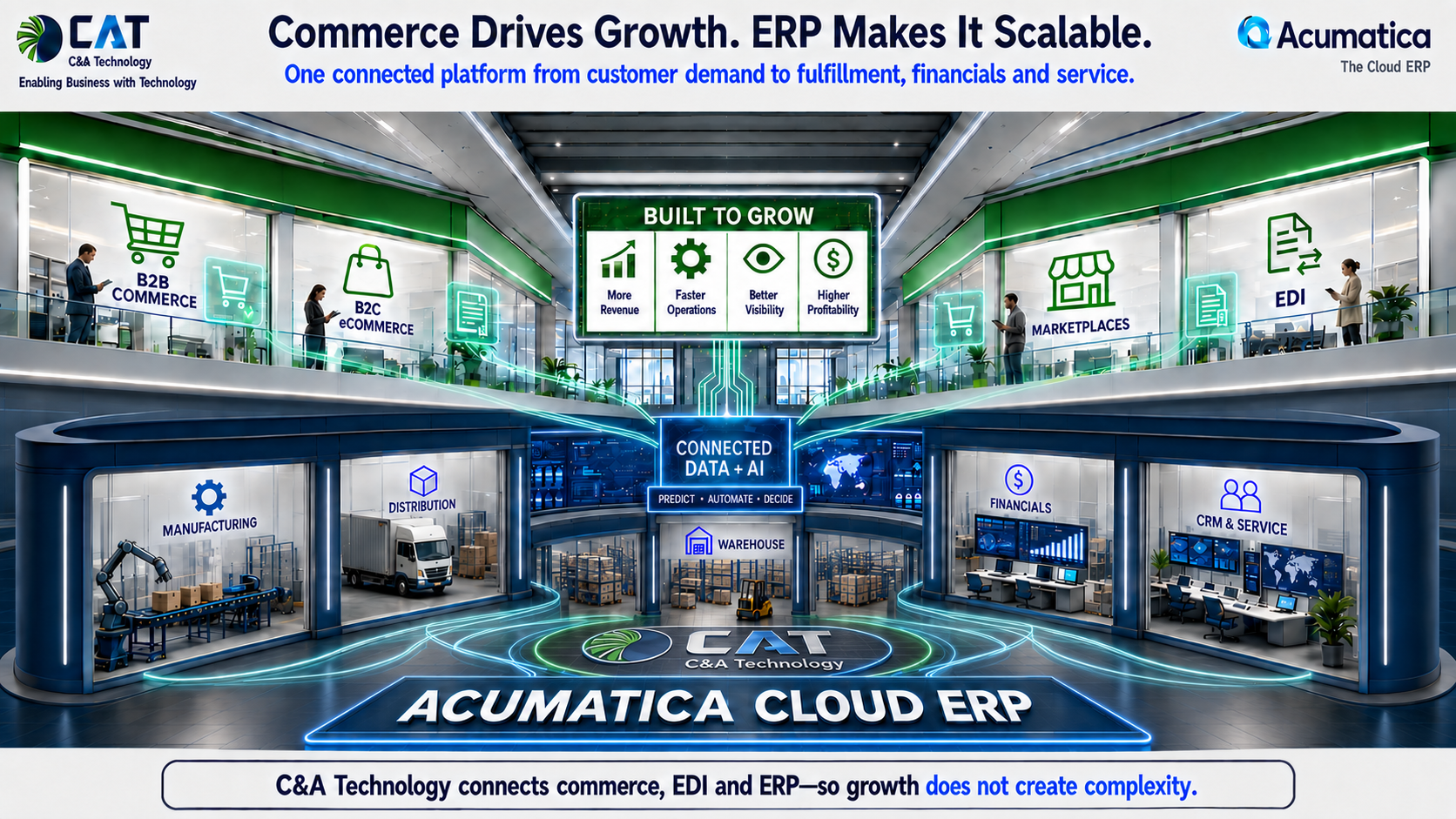
By connecting every commerce channel to Acumatica Cloud ERP, businesses can deliver a seamless customer experience, from initial demand and order placement through fulfillment, financials and ongoing service, all on one connected platform built to scale.
What Is Acumatica Cloud ERP for Retail Commerce?
Acumatica Cloud ERP for retail commerce is a comprehensive business management platform purpose-built for specialty retailers, multi-location chains, direct-to-consumer brands, and omnichannel sellers. Instead of running separate systems for POS, inventory, eCommerce, CRM, financials, and supplier EDI, a platform like Acumatica Retail Edition unifies every core process into one cloud environment, accessible from any device, in any store, at any register.
The practical result: one real-time inventory record across every store and digital channel, faster checkout and fulfillment, personalized customer experiences built on unified purchase history, and real-time financial visibility, all without nightly batch syncs.

Where Legacy Retail Technology Breaks Down, and Why Retailers Are Moving to Acumatica Cloud ERP
Most legacy retail systems were built around the register, not the customer. Inventory lived in the store where it was counted, pricing lived in whatever spreadsheet marked down last season's stock, and a store manager often couldn't see what a sister location had in the back room without a phone call. That model tolerated a "close enough" stock count because a shopper couldn't see the shelf from home.
Online shopping ended that tolerance. A shopper checking availability before driving to a store, or expecting a BOPIS order to actually be waiting at pickup, needs the count to be right, not close. Legacy systems also weren't built to reconcile POS, eCommerce, and warehouse data in real time, so retailers running them are often making buying, markdown, and staffing decisions on data that's already a day or a week stale.
That gap is exactly why retailers are moving to Acumatica now rather than waiting for a bigger budget cycle. The retailers protecting margin best aren't the ones with the fanciest storefront, they're the ones whose systems already know what's on the shelf, what's trending, and what's about to go stale, and can act on it in real time instead of finding out in next month's report.
The Omnichannel Priorities Acumatica Cloud ERP Solves for Retailers

1. Real-time, unified inventory across every channel
Cloud ERP platforms like Acumatica give retailers live visibility into inventory across every store, warehouse, in-transit shipment, and digital channel from one screen, replacing the daily batch updates and manual counts that leave stores guessing what the website is actually promising. That single view is what makes a reliable BOPIS program possible in the first place: when the system knows what's genuinely on the shelf, retailers can safely promise same-day pickup instead of hoping the count is close enough.
2. Smarter buying and replenishment
AI-assisted demand forecasting catches a slow-moving style or an emerging bestseller before the shelf tells you the hard way, and turns purchasing into an ongoing, data-informed conversation instead of a quarterly guessing game.
3. Faster, more accurate order fulfillment
Unified inventory management removes the guesswork of sourcing an order from the wrong location, cutting re-routed shipments and split-order fulfillment costs.
4. Modern, mobile store and warehouse operations
Barcode scanning, mobile counts, directed picking for ship-from-store, and cycle counting mean staff spend less time hunting for product.
5. A connected, personalized customer experience
Inaccurate inventory and the stockouts it causes translate directly into lost sales and eroded customer loyalty, costs that compound quietly over time rather than showing up in a single bad transaction.
6. AI-powered business intelligence
Retailers running AI-native forecasting catch a margin problem while there's still time to fix it, instead of finding it three months later in a quarterly review.
7. Flexible growth without ERP limitations
That flexibility is a big reason retail leadership increasingly treats ERP as a strategic growth investment rather than a back-office utility.
Key Features of Acumatica Cloud ERP Built for Retail Commerce
A POS system and an ERP bolted together isn't the same as retail-built ERP. Here's what actually needs to be native to the platform, not stitched on:
1. Point of Sale (POS) & Register Integration
Native, real-time connection between the register and inventory, so a sale at 2pm updates stock everywhere by 2:01, not at nightly close.
2. Omnichannel Order & Fulfillment Management
BOPIS, ship-from-store, curbside, and home delivery all sourced from the same live inventory record, so a promise made online is a promise the store can actually keep.
3. Matrix Items & Variant Management
Size, color, and style variants managed as one item record instead of dozens of duplicate SKUs, so "sold out in medium" doesn't quietly become a data entry problem.
4. Promotions, Markdown & Pricing Management
Scheduled markdowns, loyalty pricing, and promotional rules applied automatically across every channel at the same time, not manually re-keyed store by store.
5. Customer Loyalty & Unified Purchase History
One customer record across in-store and online purchases, so a return, a loyalty balance, or a past purchase looks the same to any associate or any channel.
6. Multi-Store Real-Time Visibility
Live inventory counts across every physical location, so a stockout at one store can be filled by a transfer or ship-from-store from another instead of losing the sale to a competitor down the street.
7. Integrated Payments & PCI Compliance
Payment processing built into the same platform that runs inventory and financials, reducing reconciliation work and audit exposure at period close.
How Acumatica Cloud ERP Implementation For Retail Commerce Actually Works
-
- Step 1: Process and channel assessment: Map current POS, eCommerce, warehouse, and financial workflows; flag data living in spreadsheets.
-
- Step 2: Configuration, not customization : Configure around multi-location inventory, loyalty pricing, and EDI requirements using native functionality.
-
- Step 3: Data migration and validation : Migrate item, customer, vendor, and transaction data; validate before go-live.
-
- Step 4: Phased go-live : Core financials and inventory first, then POS, eCommerce, and EDI.
-
- Step 5: Managed optimization : Refine workflows and layer in AI-driven forecasting post-launch. Mid-market timelines typically run 3–9 months; most retailers reach payback within 18–36 months.
C&A Technology EDI for Acumatica: Why It Belongs Inside Your Retail Cloud ERP
Retailers move a high volume of purchase orders, advance ship notices, and invoices between their systems and the vendors who stock their shelves, distribution centers, and drop-ship programs, and for big-box, grocery, and marketplace accounts, EDI compliance is usually written into the vendor agreement itself, not optional.
The gap shows up at replenishment. If EDI lives outside Acumatica, a vendor's ASN arrives in one system, gets manually reconciled against what's actually on the truck, and any discrepancy, a short shipment, a substituted SKU, doesn't surface until receiving finds it doesn't match. Keep EDI inside the same platform that runs inventory and merchandising, and that reconciliation happens automatically the moment the ASN lands, before the truck even arrives.
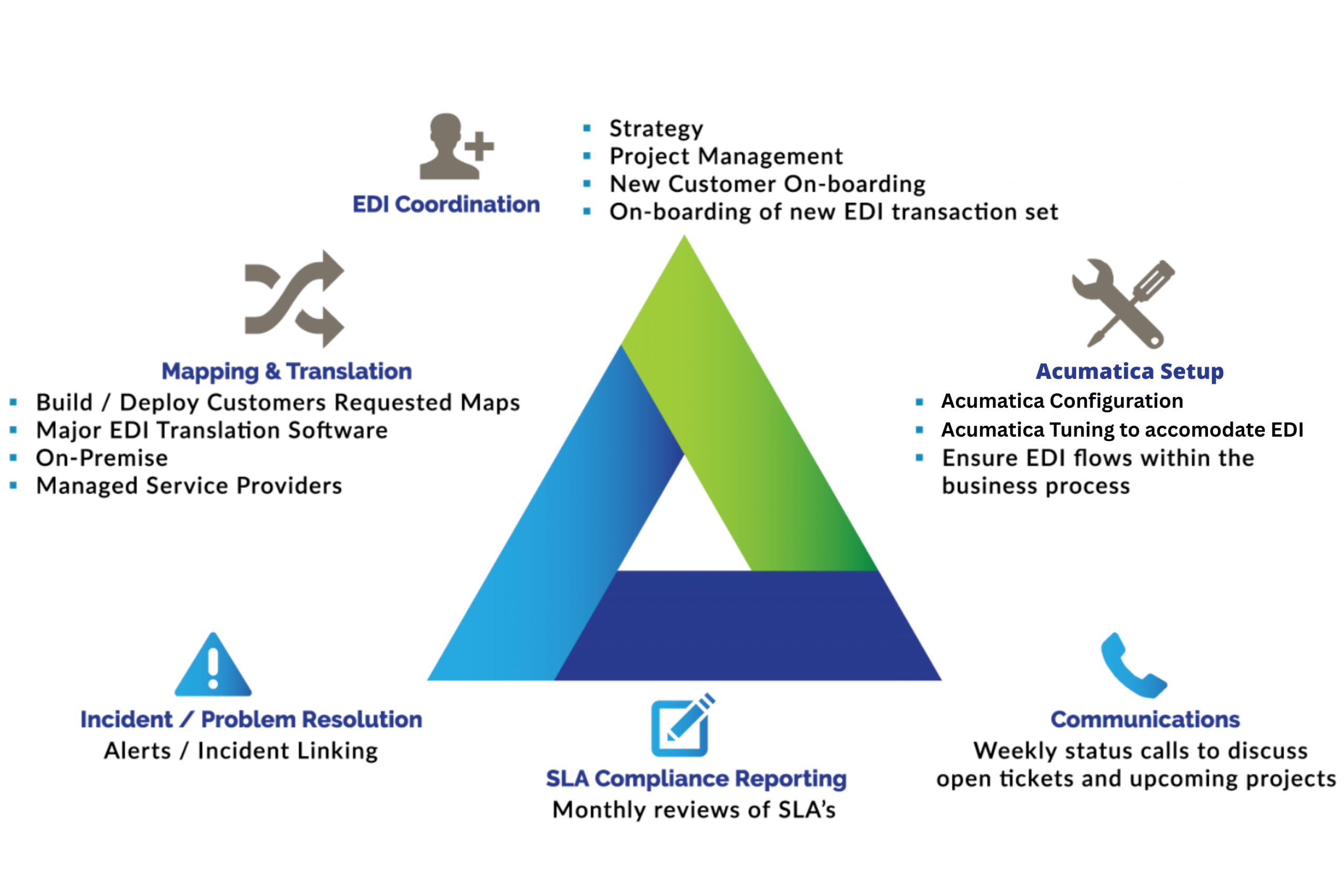
C&A Technology's EDI Managed Services for Acumatica cover the full scope of that work:
-
- EDI Coordination : Strategy, project management, new trading partner on-boarding, and on-boarding of new EDI transaction sets.
-
- Mapping & Translation: Building and deploying vendor- and partner-requested maps across major EDI translation software, on-premise systems, and managed service providers.
-
- Acumatica Setup: Acumatica configuration and tuning to accommodate EDI, ensuring it flows correctly within the broader retail business process.
-
- Incident & Problem Resolution: Alerts and incident linking so a failed transaction gets caught and fixed before it holds up a replenishment order.
-
- SLA Compliance Reporting: Monthly reviews of SLA performance.
-
- Communications: Weekly status calls covering open tickets and upcoming projects.
The result for a retailer: a vendor ASN that doesn't match the shipment gets flagged before it reaches the sales floor, big-box and grocery compliance requirements stay met without a dedicated EDI hire, and merchandising and receiving spend their time managing exceptions instead of retyping what should have transferred on its own.
Common Mistakes Retailers Make with ERP Transformation
-
- Turning on BOPIS or ship-from-store before inventory accuracy is verified on the floor, not just on paper, one wrong count turns a promised pickup into an apology at the counter.
-
- Letting store associates find out about the new system in a training video instead of on the floor. POS changes touch every transaction and every shift, and resistance shows up fastest at the register.
-
- Migrating pricing, promotions, and size/color variant data without cleaning it first, messy item attributes break omnichannel search and product matching before a customer ever sees them.
- Ignoring the retail calendar when scheduling go-live, launching new POS or inventory logic right before a holiday or back-to-school peak multiplies the risk of every other mistake on this list.
- Treating loss prevention and shrink reporting as an afterthought instead of configuring it alongside inventory from day one.
Best Practices for Getting the Most Out of Acumatica Cloud ERP
-
- Hit 95%+ inventory accuracy before flipping on BOPIS or ship-from-store, the promise is only as good as the count behind it.
-
- Build the go-live calendar around your retail calendar, not the vendor's, avoid launching new POS or inventory logic right before peak season.
-
- Give store associates mobile tools and a clear "why" before go-live, adoption resistance is highest at the register when the old process still feels faster.
-
- Treat EDI and vendor compliance as core infrastructure from day one, especially if big-box or grocery accounts are part of your vendor relationships.
-
- Sequence AI adoption deliberately, forecasting and personalization are only as good as the transactional data feeding them.
-
- Revisit pricing, promotion, and planogram configuration seasonally, retail changes with the calendar in a way most other industries don't.

Why Retail Commerce Choose C&A Technology
Selecting the right ERP is only part of a successful transformation. Implementation expertise, industry knowledge, and long-term support determine the ultimate business value.
C&A Technology brings decades of ERP consulting experience across distribution, manufacturing, supply chain, and digital transformation. Our team helps organizations modernize legacy ERP environments, reduce implementation risk, optimize business processes, integrate best-of-breed applications, enable AI-driven workflows, and deliver long-term managed services. We focus on measurable business outcomes, not simply software implementation.
FAQs - Acumatica Cloud ERP for Retail Commerce
Key Takeaways
- Acumatica Cloud ERP for retail commerce unifies POS, inventory, eCommerce, loyalty, and financials into one real-time system, so every channel is working from the same stock count and customer record.
- BOPIS and ship-from-store programs only work if inventory accuracy is verified on the floor first, promising a pickup the shelf can't back up costs more in customer trust than the program gains in convenience.
- Matrix items, promotions, and loyalty pricing need to be native to the platform, not managed in spreadsheets or bolted-on POS add-ons, or omnichannel search and pricing consistency breaks down before a customer ever notices.
- AI-assisted forecasting turns buying and markdown decisions into an ongoing, data-informed process instead of a quarterly guessing game, and catches margin problems while there's still time to fix them.
- SEDI belongs inside the ERP, not bolted on beside it, that's what keeps vendor replenishment and big-box or grocery trading partner compliance accurate and automatic.
- Mid-market implementations typically run 3–9 months, with most retailers reaching payback within 18–36 months, timed around the retail calendar rather than a vendor's preferred schedule.
- Acumatica supports mixed retail, wholesale, and marketplace business models from a single platform, with C&A Technology providing support well past go-live through Dual-Layer Managed Services.
Continue the Conversation
Retail is evolving faster than most legacy systems can follow. Success now depends on real-time inventory visibility, intelligent forecasting, and the ability to scale without a rip-and-replace every few years. Acumatica Cloud ERP for retailers provides that foundation, combined with C&A Technology's ERP expertise, managed services, AI workshops, and digital commerce capabilities, retailers gain a long-term technology partner, not just a software install.
Ready to see what this looks like for your business? Book a Consultation with C&A Technology
Book a Meeting
Related Articles
Acumatica Cloud ERP for Retail Commerce: Key Benefits from C&A Technology
The Key Benefits of Acumatica Cloud ERP For B2B Distributors: A Guide From C&A Technology

The Key Advantages of Acumatica Cloud ERP for Discrete Manufacturers: A Deep Dive with C&A Technology
What are the key benefits of using CAT’s Dual–Layer Managed Services for Acumatica Cloud ERP Systems?

Follow us online


