
July 23, 2026
The Key Advantages of Acumatica Cloud ERP for Discrete Manufacturers: A Deep Dive with C&A Technology

TL;DR
Acumatica Cloud ERP for discrete manufacturers connects engineering, production, inventory, and finance on one real-time platform, replacing the disconnected spreadsheets and legacy systems that keep shop floors guessing. Manufacturing is now the largest ERP vertical by market share, and most new ERP deployments are choosing cloud over on-premise for good reason: lower total cost of ownership, faster scaling, and, increasingly, AI built directly into scheduling, quality, and forecasting.
This blog breaks down the real advantages, the features that matter most for discrete manufacturers, and the best practices C&A Technology uses when implementing Acumatica for manufacturing clients.
Let's talk about Acumatica Cloud ERP Built for Discrete Manufacturers
The Key Advantages of Acumatica Cloud ERP for Discrete Manufacturers
Manufacturing is now the largest single vertical in the global ERP market, holding roughly 32% of total ERP spending, and 53% of businesses rank ERP as a priority investment, with manufacturing and distribution leading adoption.
That's not a coincidence; it's a direct response to years of supply chain volatility, labor shortages, and customers who expect delivery dates that legacy, disconnected systems simply can't promise with confidence.
Acumatica Cloud ERP for discrete manufacturers is a cloud-hosted enterprise resource planning system that unifies engineering, production scheduling, shop floor control, inventory, and financials into a single, real-time platform, replacing the spreadsheets, standalone MRP tools, and on-premise systems that keep departments working from different versions of the truth.
For companies that build distinct, countable, finished products, machinery, electronics, industrial equipment, consumer goods, the shift to cloud ERP isn't just an IT upgrade. It's the difference between reacting to problems after they've already cost you money and catching them before they do. Below, we break down why that shift matters right now, what to actually look for in a system, and how C&A Technology approaches Acumatica implementations for discrete manufacturers specifically.
Acumatica runs as a single platform, which means the same core system C&A Technology implements for discrete manufacturers also powers B2B distributor and retail commerce operations elsewhere.
Beyond Discrete Manufacturing: One Connected Acumatica Platform for Discrete Manufacturing, B2B Distribution & Digital Commerce
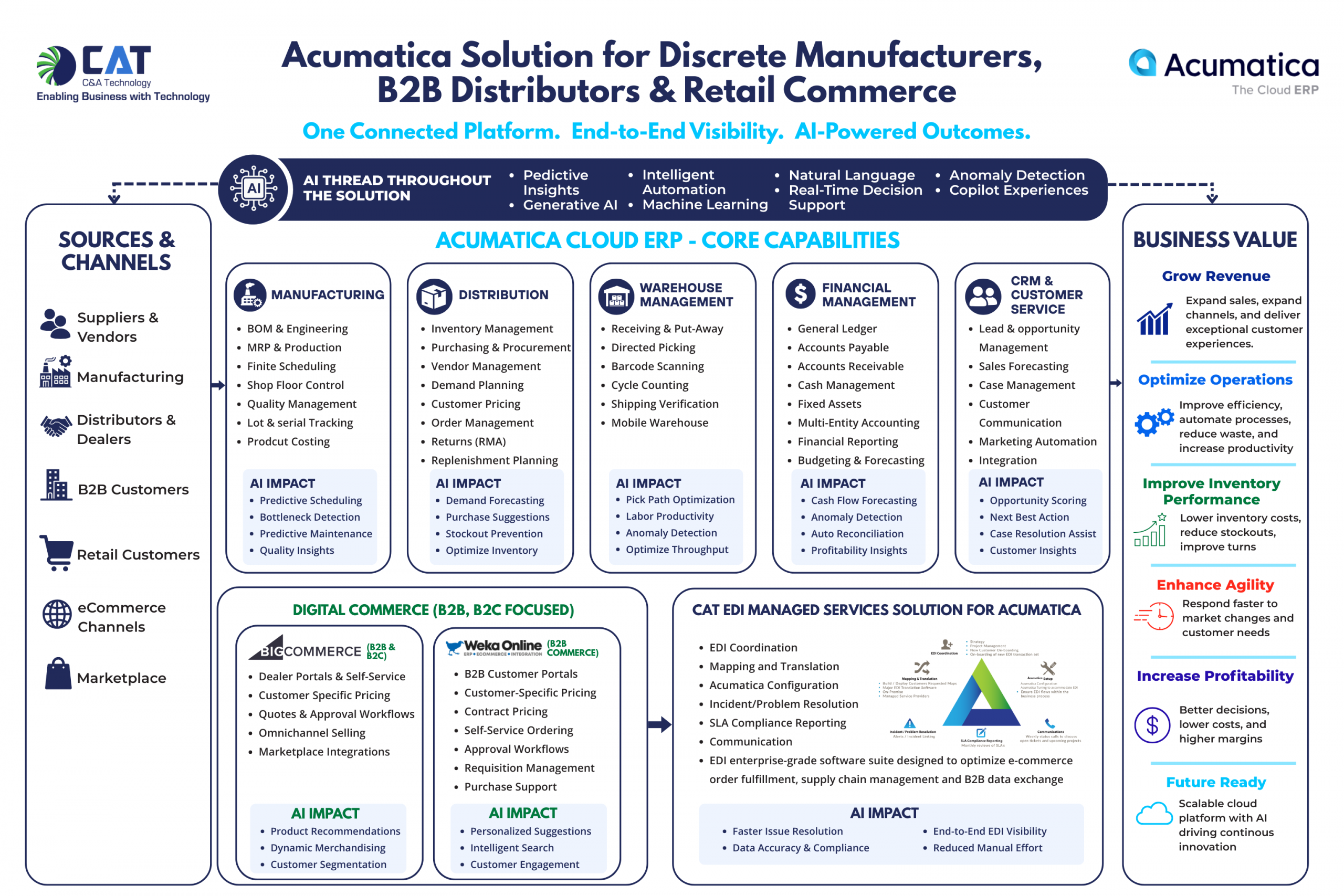
Today’s discrete manufacturers increasingly operate across multiple business models. They don’t simply manufacture products, they source materials, manage complex inventory and warehouses, distribute through B2B channels, sell directly to customers and dealers, support digital commerce, and exchange high volumes of transactions electronically with trading partners. Acumatica Cloud ERP brings these operations together within one connected platform, extending beyond discrete manufacturing to provide integrated capabilities for distribution, warehouse management, financials, CRM and customer service, B2B and retail digital commerce, and EDI.
C&A Technology builds on this foundation to deliver a holistic, end-to-end Acumatica solution set for discrete manufacturers, B2B distributors, and retail/digital commerce organizations. The result is connected data and visibility from suppliers and production through inventory, fulfillment, commerce, EDI, and the customer, while AI is threaded throughout the solution to support predictive insights, intelligent automation, anomaly detection, natural-language interaction, and better real-time decision-making.
The solution framework below illustrates how Acumatica Cloud ERP Core Capabilities, Digital Commerce, and CAT EDI Managed Services work together to create a connected platform designed to help organizations grow revenue, optimize operations, improve inventory performance, increase agility and profitability, and build a foundation for future growth.
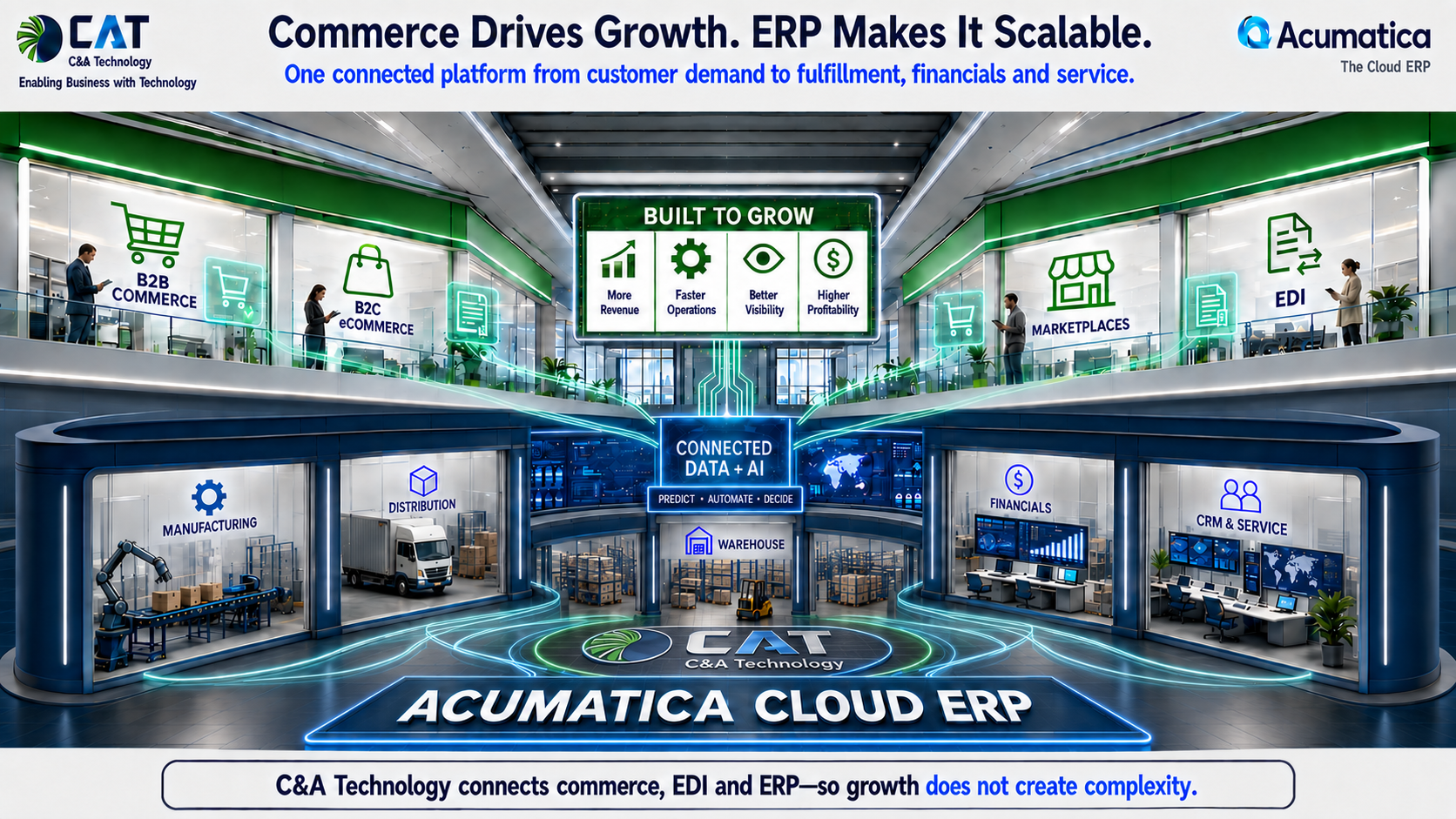
By connecting every commerce channel to Acumatica Cloud ERP, businesses can deliver a seamless customer experience, from initial demand and order placement through fulfillment, financials and ongoing service, all on one connected platform built to scale.
What Is Acumatica Cloud ERP for Discrete Manufacturers?
Acumatica Cloud ERP for discrete manufacturers is enterprise software, hosted and maintained off-site by the vendor, that manages the specific workflows of discrete production: bills of material (BOM), engineering change control, material requirements planning (MRP), finite scheduling, shop floor data collection, lot and serial traceability, and product costing, all tied to the same financial and CRM data the rest of the business runs on.
Unlike generic or process-manufacturing ERP, a discrete manufacturing Acumatica cloud ERP is built around assembling distinct units from components, not blending batches or running continuous formulas. That distinction matters when you're evaluating software, because features like matrix items, engineering change orders, and serial-level traceability are far more central to discrete production than they are to, say, a chemical or food and beverage plant.
Why Discrete Manufacturers Are Moving to Acumatica Cloud ERP Now
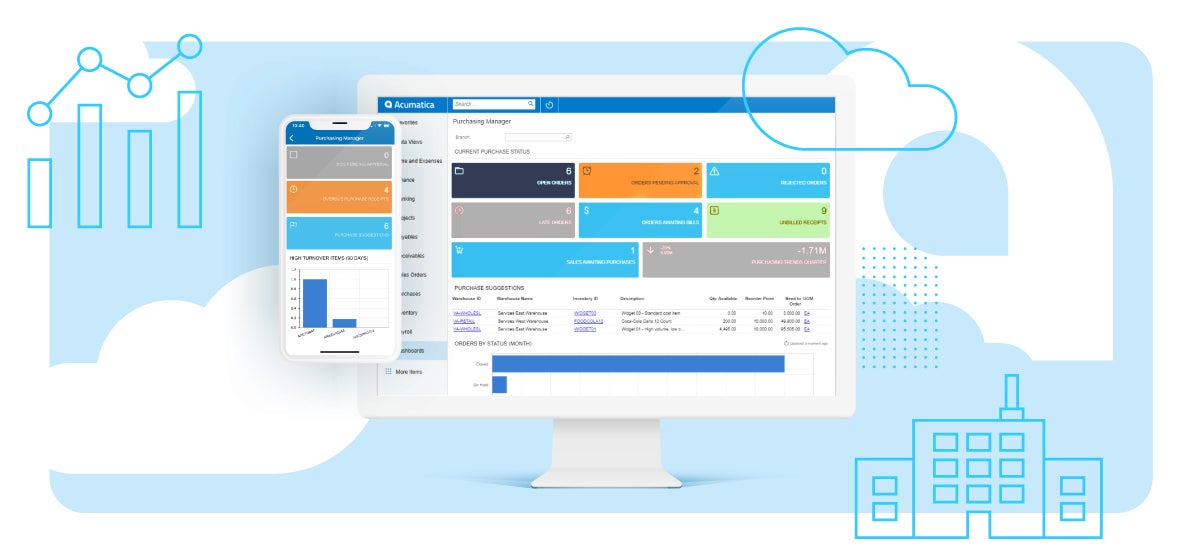
With Acumatica cloud ERP, costs come down and flexibility goes up drastically. It cuts upfront hardware spend and the IT burden of patching and securing on-site servers, and its pay-as-you-go model lets manufacturers scale up or down as demand shifts, something legacy systems can't do.
For discrete manufacturers, the operational case matters just as much. Disconnected legacy systems create blind spots that turn a minor supply delay into a missed customer commitment: purchasing doesn't see what production needs until it's urgent, finance doesn't see true product cost until the month closes, and the shop floor often still runs on paper travelers or spreadsheets.
The manufacturers who handled recent supply chain disruption best were largely the ones already running connected, cloud-based systems, they could spot the problem and reroute around it in days, not weeks.
How Acumatica Cloud ERP Enhances Agility and Innovation for Discrete Manufacturers
This is the piece most legacy ERP conversations still miss: agility isn't just about being cloud-hosted, it's about what the system does with the data once it's centralized. On Acumatica specifically, that increasingly means AI working directly inside manufacturing workflows, not bolted on as a separate reporting tool.
1. Predictive Scheduling and Bottleneck Detection
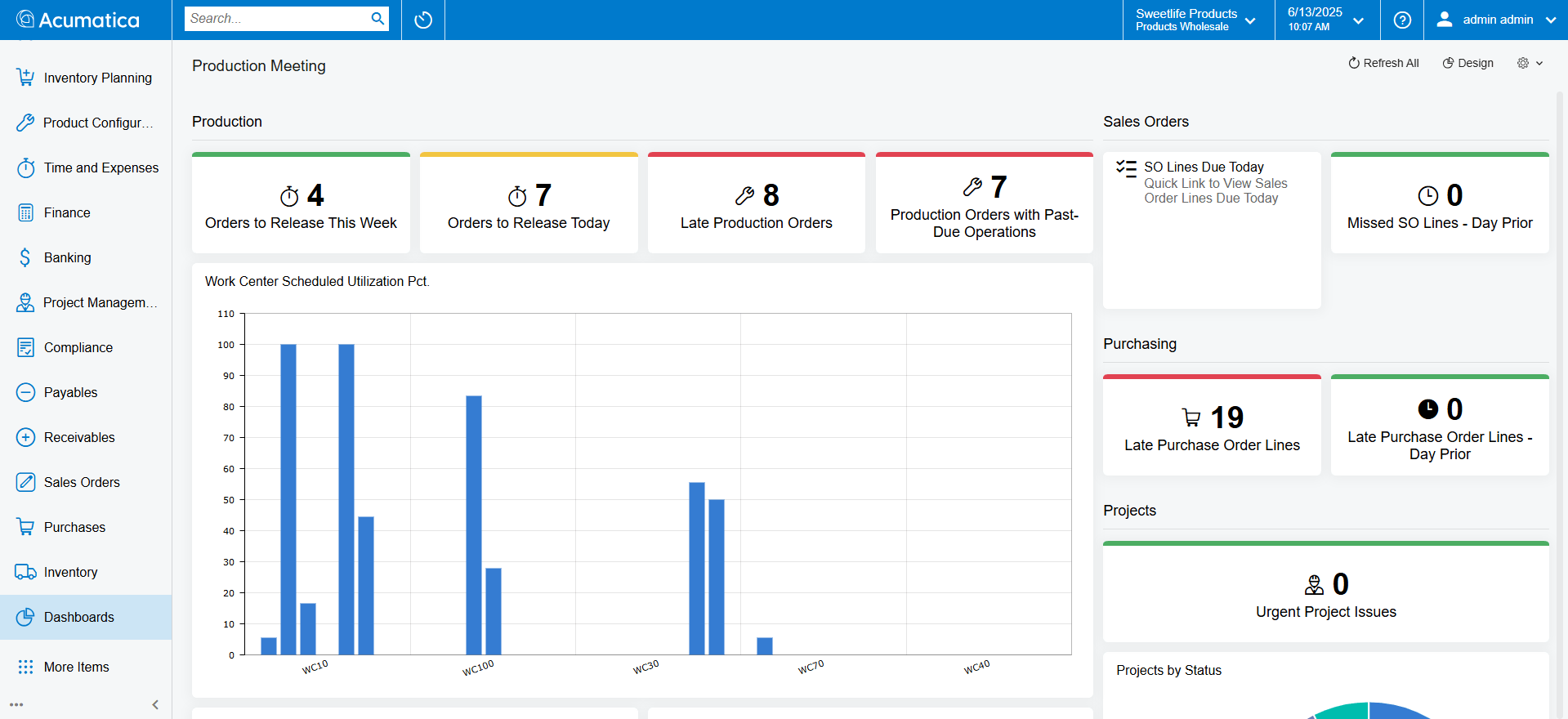
Instead of scheduling production against static due dates, AI-assisted scheduling inside a modern Acumatica cloud ERP reads real machine and labor capacity and flags where a work order is likely to slip before it slips, giving planners the chance to rebalance the schedule instead of explaining a missed ship date after the fact.
2. Real-Time Shop Floor Visibility
Barcode-driven time capture and mobile data entry mean production status, labor hours, and machine utilization update the moment they happen, not at the end of the shift, when it's too late to adjust.
3. Flexible Scaling as Product Lines Change
Because Acumatica cloud ERP is modular and subscription-based, adding a new production line, entity, or warehouse doesn't require a new server or a multi-month IT project; it's a configuration change, not a capital expense.
4. AI-Driven Quality and Maintenance Insights
Quality management modules paired with AI can surface non-conformance patterns and predictive maintenance flags, catching a drifting tolerance or an underperforming machine before it produces a batch of scrap.
Key Features of Acumatica Cloud ERP Built for Discrete Manufacturing
Not every "manufacturing ERP" is actually built for discrete production. When evaluating a discrete manufacturing ERP software, look for these core capabilities:
1. BOM & Engineering
Multi-level bills of material with full engineering change control, so a design revision doesn't get lost between engineering and the shop floor.
2. MRP & Production Planning
Material requirements planning that converts sales demand directly into production and purchasing schedules.
3. Finite Scheduling
Scheduling logic based on actual machine and labor capacity, not just calendar due dates.
4. Shop Floor Control
Real-time labor and machine time capture directly from the production floor.
5. Quality Management
Inspection plans, non-conformance tracking, and corrective action workflows tied to specific work orders.
6. Lot & Serial Tracking
Full genealogy from incoming raw material lot to the specific serial number that shipped to a customer.
7. Product Costing
Standard, actual, and average costing with visibility into where variances are actually coming from.
C&A Technology EDI for Acumatica: Why It Belongs Inside Your Acumatica Cloud ERP
Most discrete manufacturers don't just build products, they exchange a constant stream of purchase orders, advance ship notices, and invoices with the large customers and suppliers they sell to and buy from, many of whom require EDI as a condition of doing business at all. Automotive, industrial equipment, and electronics buyers in particular routinely mandate EDI compliance from their manufacturing suppliers.
When EDI runs as a separate system bolted onto the ERP, someone is usually re-keying data by hand between the two, which is exactly the kind of manual step that introduces errors and slows order fulfillment. When EDI is managed as part of the same cloud ERP platform, that translation happens automatically, and everyone, planning, shipping, finance, is working from the same order data in real time.
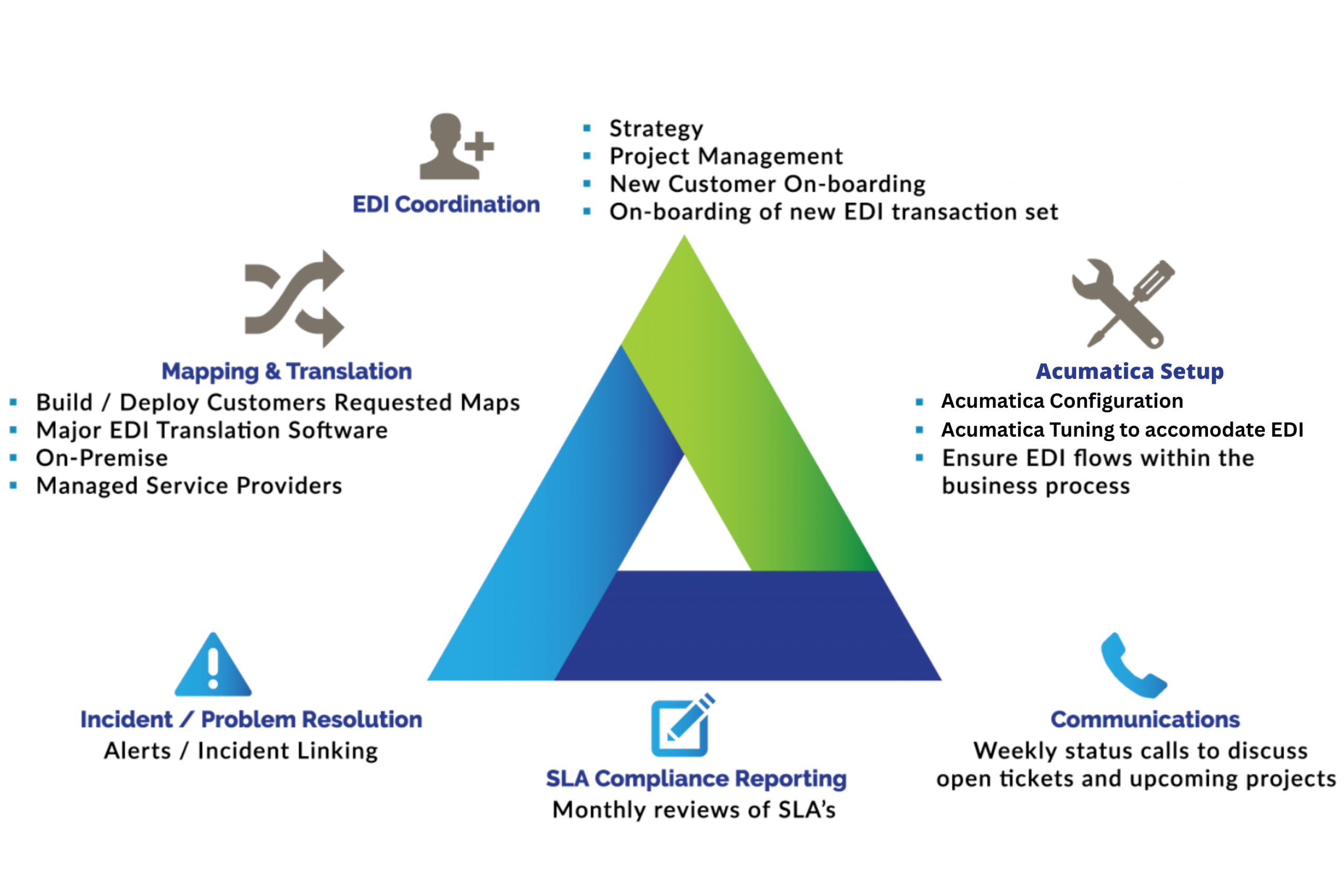
C&A Technology's EDI Managed Services for Acumatica cover the full scope of that work:
- EDI Coordination: Strategy, project management, new customer on-boarding, and on-boarding of new EDI transaction sets.
- Mapping & Translation: Building and deploying customer-requested maps across major EDI translation software, on-premise systems, and managed service providers.
- Acumatica Setup: Acumatica configuration and tuning to accommodate EDI, ensuring EDI flows correctly within the broader business process.
- Incident & Problem Resolution: Alerts and incident linking so a failed transaction gets caught and fixed before it holds up an order.
- SLA Compliance Reporting: Monthly reviews of SLA performance.
- Communications: Weekly status calls covering open tickets and upcoming projects.
For a discrete manufacturer, that typically means faster resolution when an order fails to map correctly, better accuracy on the data flowing to and from key accounts, full visibility into EDI transactions end-to-end, and considerably less manual re-entry for the team.
Common Mistakes Discrete Manufacturers Make When Adopting Cloud ERP
Even strong software fails when the rollout repeats the same avoidable mistakes:
- Treating implementation as a lift-and-shift: Copying legacy processes into new software instead of rethinking workflows just digitizes the same inefficiencies.
- Skipping BOM and inventory cleanup before go-live: Dirty master data guarantees inaccurate MRP output from day one.
- Underestimating shop floor training: A system operations never adopts on the floor never delivers the visibility it was bought for.
- Choosing a generalist implementation partner: Discrete manufacturing has enough nuance (matrix items, engineering change orders, serial traceability) that generic ERP experience isn't a substitute for industry-specific configuration knowledge.
- Ignoring AI capabilities as "not ready yet: Predictive scheduling and anomaly detection are already live inside modern cloud ERP — deferring adoption just delays the ROI.
Best Practices for Discrete Manufacturers to Maximize ROI
Adopting Acumatica cloud ERP is a meaningful investment, here's how C&A Technology helps discrete manufacturers get the most out of it:
- Start With Process Mapping, Not Configuration: Document how work actually moves through your shop floor today before configuring a single screen. Software should be shaped around your real workflow, not the other way around.
- Prioritize Modules With the Fastest Payback: Inventory accuracy and shop floor data capture typically deliver visible ROI fastest, sequence your rollout to build momentum and internal buy-in early.
- Involve Shop Floor Staff Before Go-Live, Not After: The people who will use the system daily should shape how it's configured. Systems designed only by management consistently see lower floor-level adoption.
- Choose an Implementation Partner With Manufacturing-Specific Depth: A partner who understands BOM structures, engineering change control, and lot traceability configures a fundamentally more useful system than one applying a generic ERP playbook.
- Plan for AI Adoption From Day One: Predictive scheduling, anomaly detection, and quality insights are strongest when the underlying data is clean from the start, don't treat AI as a "phase two" add-on.
- Measure ROI Against Specific, Named KPIs: On-time delivery percentage, inventory turns, and scrap rate are concrete, measurable ways to prove the system is paying for itself, track them from before go-live, not just after.

How C&A Technology Delivers Acumatica for Discrete Manufacturers
C&A Technology is an Acumatica implementation partner focused specifically on manufacturing and distribution clients. Our implementations are built around BOM structure, engineering change control, and shop floor realities from day one, rather than adjusted after go-live once the gaps surface.
Our team has hands-on discrete manufacturing experience, which means less time spent explaining industry-specific requirements and more time spent configuring for them. Our Support doesn't stop at go-live, either. C&A Technology runs ongoing Dual-Layer Acumatica managed services for the ERP platform itself, and for adjacent functions like EDI, so manufacturers have one point of accountability instead of juggling separate vendors for implementation, support, and trading partner integration.
FAQs - Acumatica Cloud ERP for Discrete Manufacturers
Key Takeaways
- Manufacturing is now the largest ERP vertical by market share, and most new ERP deployments are choosing cloud over on-premises.
- Discrete manufacturing ERP needs specific capabilities: BOM/engineering control, finite scheduling, lot/serial tracking; generic business software doesn't handle these well.
- AI is increasingly built directly into Acumatica cloud ERP scheduling, quality, and forecasting, not sold as a separate add-on.
- The most common implementation failures come from process, not software: skipped data cleanup, late floor-staff involvement, and generalist implementation partners.
- Real ROI shows up fastest in cross-department handoffs, especially engineering-to-shop-floor and purchasing-to-production visibility.
Continue the Conversation
Discrete manufacturers aren't adopting Acumatica cloud ERP because it's trendy; they're adopting it because disconnected legacy systems have a real, measurable cost: missed delivery dates, scrap from outdated specs reaching the floor, and decisions made on gut instinct instead of real-time data. Manufacturing is now the single largest ERP vertical for exactly this reason, and the gap between companies running connected cloud systems and those still patching together spreadsheets keeps widening.
The advantages are real, but they aren't automatic; they depend on choosing software actually built for discrete production, and an implementation partner who configures it around how your shop floor actually runs. That's the deep dive: Acumatica cloud ERP for discrete manufacturers, done right, with C&A Technology.
Schedule a meeting built around your specific production workflow. C&A Technology will walk through exactly how Acumatica handles your BOM structure, scheduling, and shop floor data.
Book a Meeting
Related Articles
Acumatica Cloud ERP for Retail Commerce: Key Benefits from C&A Technology

The Key Benefits of Acumatica Cloud ERP For B2B Distributors: A Guide From C&A Technology
The Key Advantages of Acumatica Cloud ERP for Discrete Manufacturers: A Deep Dive with C&A Technology
What are the key benefits of using CAT’s Dual–Layer Managed Services for Acumatica Cloud ERP Systems?

Follow us online


