
July 31, 2026
The Key Benefits of Acumatica Cloud ERP For B2B Distributors: A Guide From C&A Technology

TL;DR
Acumatica Cloud ERP for B2B distributors replaces disconnected inventory, purchasing, warehouse, and financial systems with one real-time platform, and the shift is no longer optional. Distributors running modern cloud ERP report double-digit gains in inventory accuracy, faster order cycles, and stronger margins, while legacy systems increasingly can't keep pace with buyer expectations for real-time visibility and self-service.
This blog breaks down what Acumatica cloud ERP for B2B distributors actually does, the specific advantages it delivers, and how C&A Technology helps distributors get there without disrupting day-to-day operations. .
Let's talk about Acumatica Cloud ERP Built for B2B Distributors
The Key Benefits of Acumatica Cloud ERP for B2B Distributors
B2B buyers now expect the same self-service, real-time experience they get from consumer platforms, and they're not waiting for suppliers to catch up. If your distribution business is still reconciling inventory across spreadsheets, a standalone WMS, and a 15-year-old ERP, that buyer has already moved on to a competitor who can show them accurate stock and pricing the moment they ask.
Acumatica Cloud ERP for B2B distributors is a unified, browser-based platform that connects inventory, purchasing, warehousing, sales, financials, Digital Commerce and EDI into a single source of truth, replacing the patchwork of disconnected systems most distributors have relied on for decades. It gives every team, from purchasing to customer service, the same real-time data at the same moment.
That matters right now because the pressure on distributors is compounding from every direction at once: buyers expect Amazon-like self-service, margins keep tightening, supply chains stay unpredictable, and leadership is being asked to adopt AI without adding headcount. Legacy ERP simply was not built to carry that load.
Here's what a modern cloud ERP platform changes, what it takes to get there, and where distributors most often go wrong along the way.
Beyond B2B Distribution: One Connected Acumatica Platform for B2B Distribution, Discrete Manufacturing, and Digital Commerce
A distributor's data doesn't come from one place. Purchase orders arrive from B2B customers and retail accounts, replenishment signals come from vendors and manufacturing partners, and orders increasingly originate from a storefront or marketplace instead of a phone call. Acumatica Cloud ERP is built to pull all of that into one system rather than reconciling it after the fact, and distribution is one leg of a platform that also runs manufacturing, warehouse operations, financials, and customer service for the same client base.
C&A Technology implements that full platform, not a distribution-only slice of it. A distributor that also assembles kits, a manufacturer that ships through its own distribution arm, and a retailer that wholesales alongside its storefront are all running the same underlying Acumatica foundation, just configured around different workflows. What connects them is the data: inventory, purchasing, fulfillment, and the customer record stay visible end-to-end, with AI, forecasting, anomaly detection, natural-language reporting, working across every one of those functions instead of sitting in a single module.
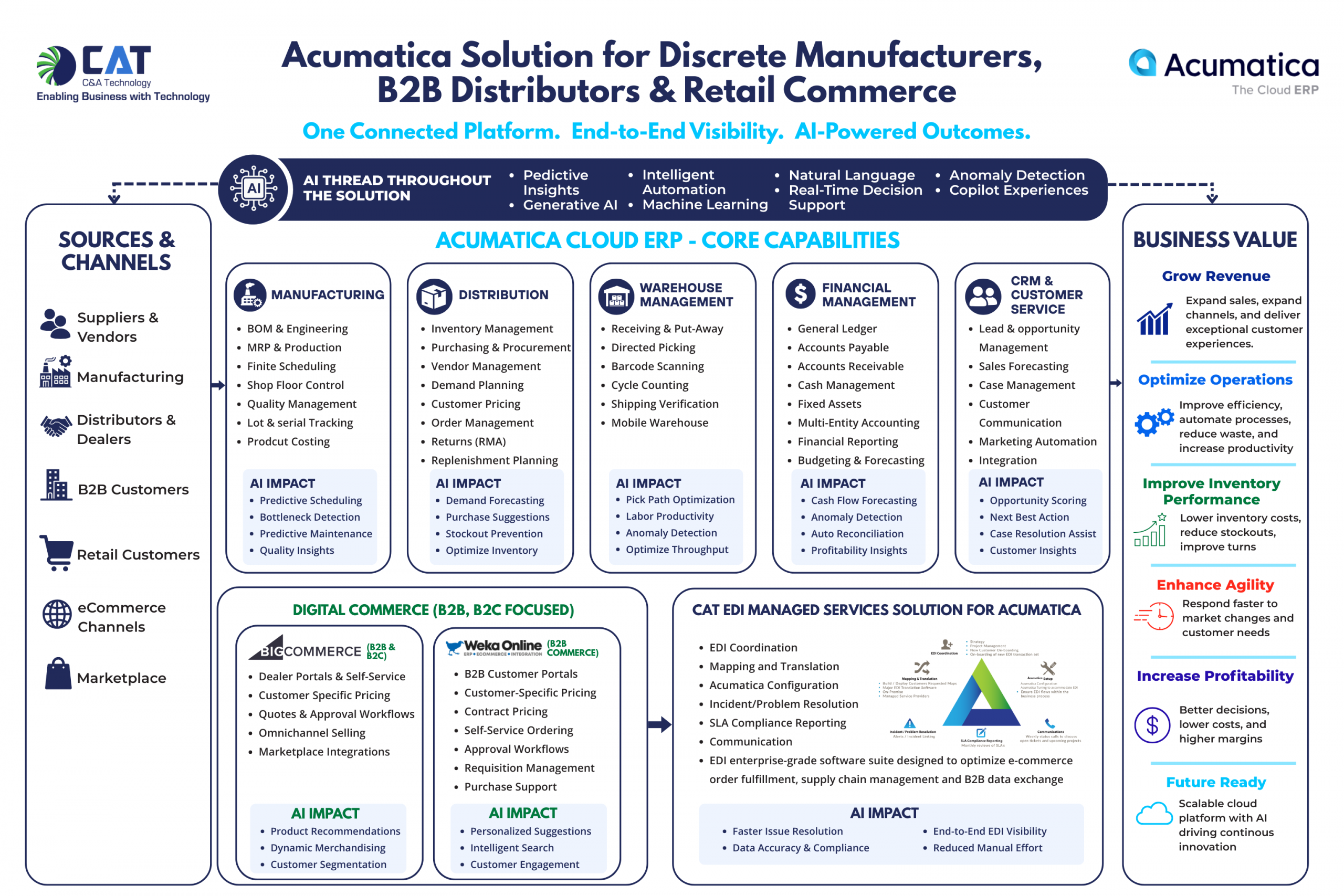
The framework below maps how that plays out: Acumatica's Core Capabilities, Digital Commerce, and CAT's EDI Managed Services operating as one connected system, feeding directly into the outcomes that matter most for a distributor, revenue growth, tighter inventory performance, and the agility to respond when a vendor, a channel, or a customer's order pattern shifts.
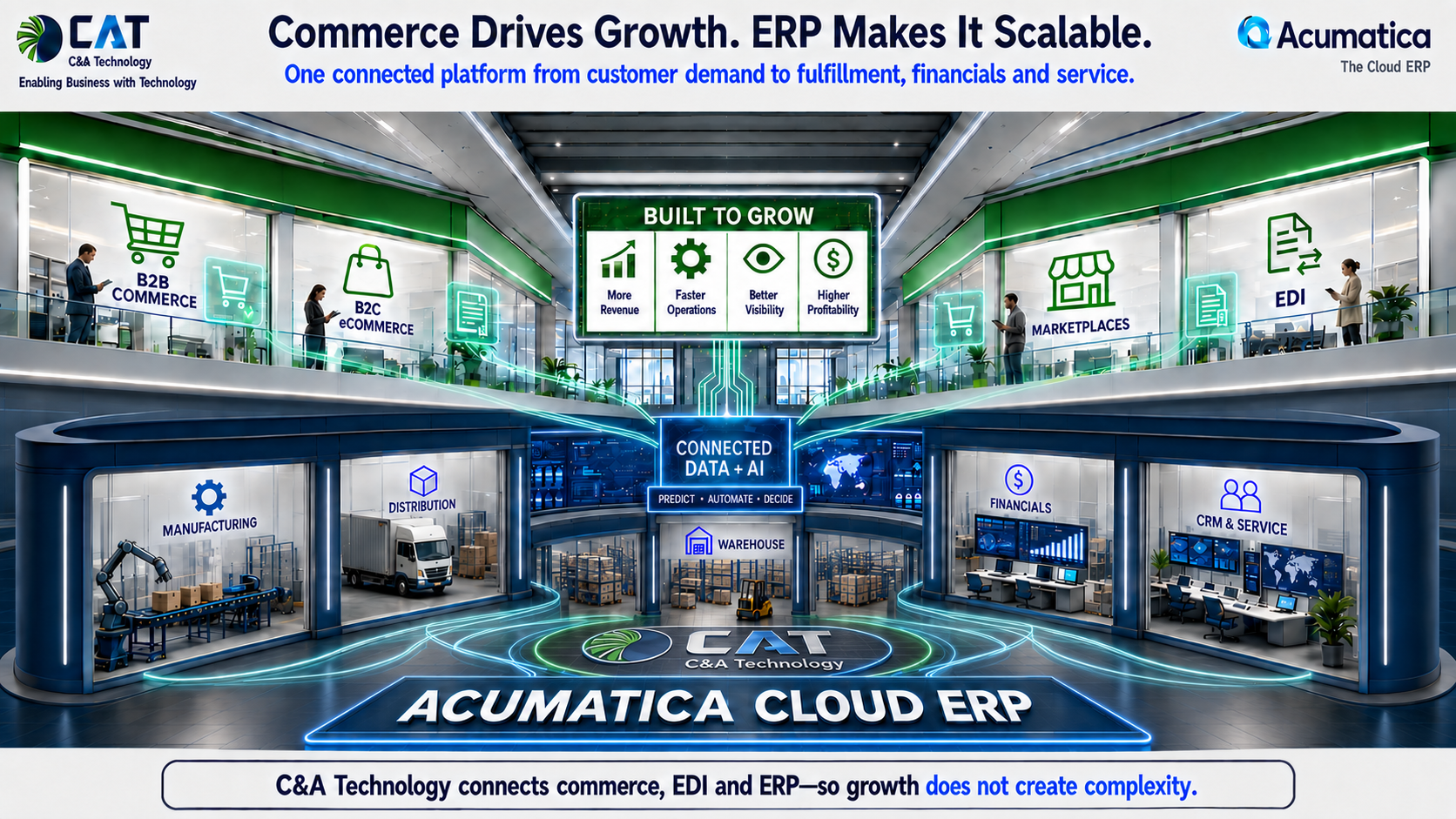
By connecting every commerce channel to Acumatica Cloud ERP, businesses can deliver a seamless customer experience, from initial demand and order placement through fulfillment, financials and ongoing service, all on one connected platform built to scale.
What is Acumatica Cloud ERP for B2B Distributors?
"The distributors winning right now aren't the ones with the most systems, they're the ones with the fewest disconnected ones."
Acumatica Cloud ERP for B2B distributors is a comprehensive business management platform purpose-built for wholesalers, importers, industrial suppliers, value-added resellers, and multi-channel distributors. Instead of running separate systems for purchasing, inventory, warehouse management, CRM, financials, eCommerce, and EDI, a platform like Acumatica Distribution Edition unifies every core process into one cloud environment accessible from any device.
The practical result: Complete inventory visibility, faster order fulfillment, smarter purchasing decisions, stronger customer relationships, and real-time financial reporting, all from the same system, updated in real time, without nightly batch syncs or manual exports.
Why Legacy Systems Are Holding B2B Distributors Back and Moving to Acumatica Cloud ERP Now
Most legacy distribution ERPs were designed for a world where customers called in orders, purchasing ran on quarterly forecasts, and "good enough" inventory accuracy meant occasionally over-ordering to compensate. That world is gone.
Legacy platforms also weren't built for AI. As embedded intelligence becomes standard across ERP vendors, distributors on outdated systems are locked out of forecasting and automation capabilities their competitors are already using to cut costs and respond faster.
The Operational Priorities Acumatica Cloud ERP Solves for B2B Distributors

1. Complete Inventory Visibility
"Inventory is the single largest investment most distributors carry, and the one most often managed with the least real-time visibility."
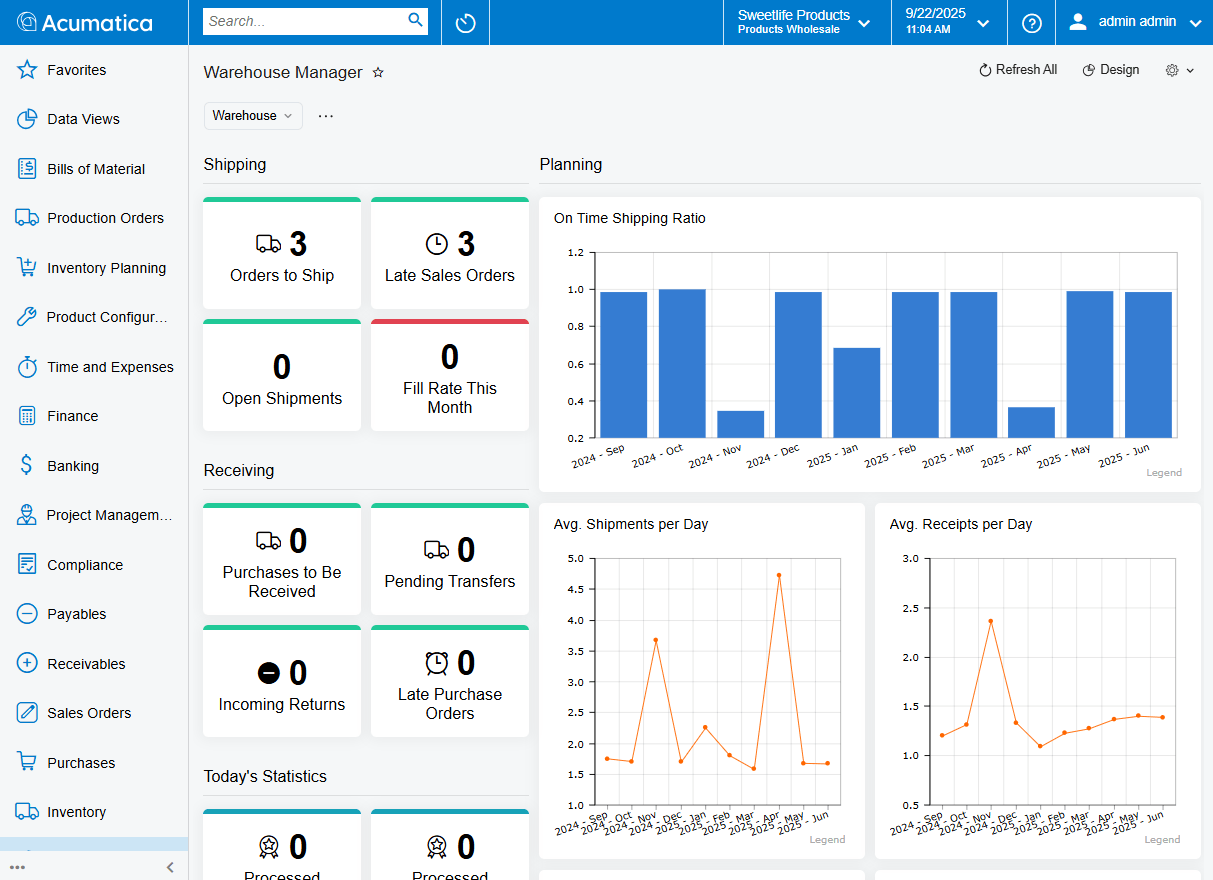
Inventory is one of the largest capital investments any distributor makes, yet it's frequently the least visible in real time. Acumatica Cloud ERP platforms provide live visibility across multiple warehouses, branch locations, third-party logistics providers, in-transit inventory, vendor-managed inventory, and customer allocations, all from one screen.
2. Smarter Purchasing and Replenishment
Demand doesn't sit still, and neither should purchasing. Acumatica Cloud ERP uses historical demand, seasonal trends, vendor lead times, vendor performance, safety stock levels, reorder points, and AI-assisted recommendations to turn purchasing from a reactive function into a proactive one.
This is also where AI-enabled ERP delivers some of its clearest ROI: organizations running AI-enabled ERP get improvement in forecasting accuracy and a reduction in operational costs.
3. Faster Order Processing
From sales order entry and validation through inventory allocation, picking, packing, shipping, and invoicing, Acumatica cloud ERP streamlines the full order lifecycle in one connected workflow. That reduces manual re-keying, cuts errors, and shortens the time between "order placed" and "order shipped."
4. Modern Warehouse Operations
Warehouse productivity is a direct line to profitability. Acumatica Cloud ERP platforms support barcode scanning, mobile warehouse operations, directed picking and put-away, cycle counting, lot and serial tracking, and warehouse transfers, so staff spend less time searching for product and more time fulfilling orders.
5. Better Customer Experience
Customer service teams gain instant access to order history, inventory availability, shipment tracking, pricing, credit status, and prior communications, all in the same record.
Faster, more accurate responses translate directly into stronger retention, particularly as more B2B buyers say they prefer a rep-free buying experience and expect self-service to be seamless on the occasions they do need help.
6. AI-Powered Business Intelligence
Modern distributors need more than static reports; they need actionable, real-time insight. Acumatica Cloud ERP delivers AI-assisted analytics, demand forecasting, inventory optimization, margin analysis, sales performance dashboards, executive reporting, and automated exception alerts, so decision-makers spend less time collecting data and more time acting on it.
Acumatica has continued to expand this capability through embedded AI and workflow automation built directly into the platform, rather than bolted on as a separate reporting layer.
7. Flexible Growth Without ERP Limitations
As distributors expand into new warehouses, additional product lines, new geographic markets, acquisitions, or digital sales channels, Acumatica cloud ERP scales alongside them instead of forcing a costly platform replacement three years later. That flexibility is precisely why businesses across manufacturing and distribution now treat ERP as a top-tier strategic investment rather than a back-office utility.
Key Features of Acumatica Cloud ERP Built for B2B Distributors
Plenty of software calls itself a "distribution ERP" without actually handling the mechanics of wholesale, multi-warehouse, or multi-channel selling. Here's what to check for before you commit to one:
1. Multi-Warehouse Inventory Management
Real-time inventory visibility and control across every warehouse, branch, and third-party logistics location.
2. Purchasing & Replenishment
Automated reorder points, vendor performance tracking, and demand-driven purchasing recommendations.
3. Warehouse Management
Barcode scanning, directed picking and put-away, wave picking, and cycle counting from the floor.
4. Advanced Pricing & Customer-Specific Contracts
Tiered, contract, and customer-specific pricing applied automatically at order entry.
5. Lot & Serial Tracking
Full traceability from receiving through shipment for regulated or high-value goods.
6. Sales Order & Fulfillment Management
Order entry, allocation, and fulfillment tracked in one connected workflow from quote to cash.
7. Landed Cost & Product Costing
True landed cost visibility across freight, duties, and vendor terms, so margin isn't a surprise at month-end.
How Acumatica Cloud ERP Implementation For B2B Distributors Actually Works
Moving to Acumatica cloud ERP isn't a single event; it's a structured process. Distributors that succeed typically follow a version of this path:
-
- Step 1: Process and data assessment: Map current purchasing, inventory, warehouse, and financial workflows, and flag where data lives in spreadsheets or disconnected point solutions.
-
- Step 2: Configuration, not customization : Configure the ERP to match distribution-specific needs, multi-warehouse rules, lot/serial tracking, EDI trading partner requirements, using native functionality wherever possible to avoid costly custom code.
-
- Step 3: Data migration and validation : Migrate customer, vendor, item, and historical transaction data, then validate accuracy before go-live. This step is where most timeline slippage happens if it's rushed.
-
- Step 4: Phased go-live : Roll out core financials and inventory first, followed by warehouse mobility, EDI, and digital commerce integrations, so teams aren't absorbing every change at once.
-
- Step 5: Managed optimization : Post-launch, refine workflows, expand automation, and layer in AI-driven forecasting as teams grow comfortable with the new system.
C&A Technology EDI for Acumatica: Why It Belongs Inside Your Distribution Cloud ERP
Purchase orders, advance ship notices, invoices, most B2B distributors are running a constant back-and-forth of electronic transactions with the customers and vendors they depend on, and for accounts in grocery, big-box, or industrial supply, EDI compliance usually isn't optional, it's a condition of keeping the account.
The trouble starts when EDI sits outside the ERP as its own system. A customer's PO comes in through one tool, gets keyed into Acumatica by hand, and any mismatch between the two, a wrong item code, a price that didn't sync, surfaces days later as a fulfillment problem instead of getting caught on the spot. Run EDI through the same platform that holds inventory and pricing, and that translation step disappears; purchasing, the warehouse, and finance are all reading from the same order the moment it lands.
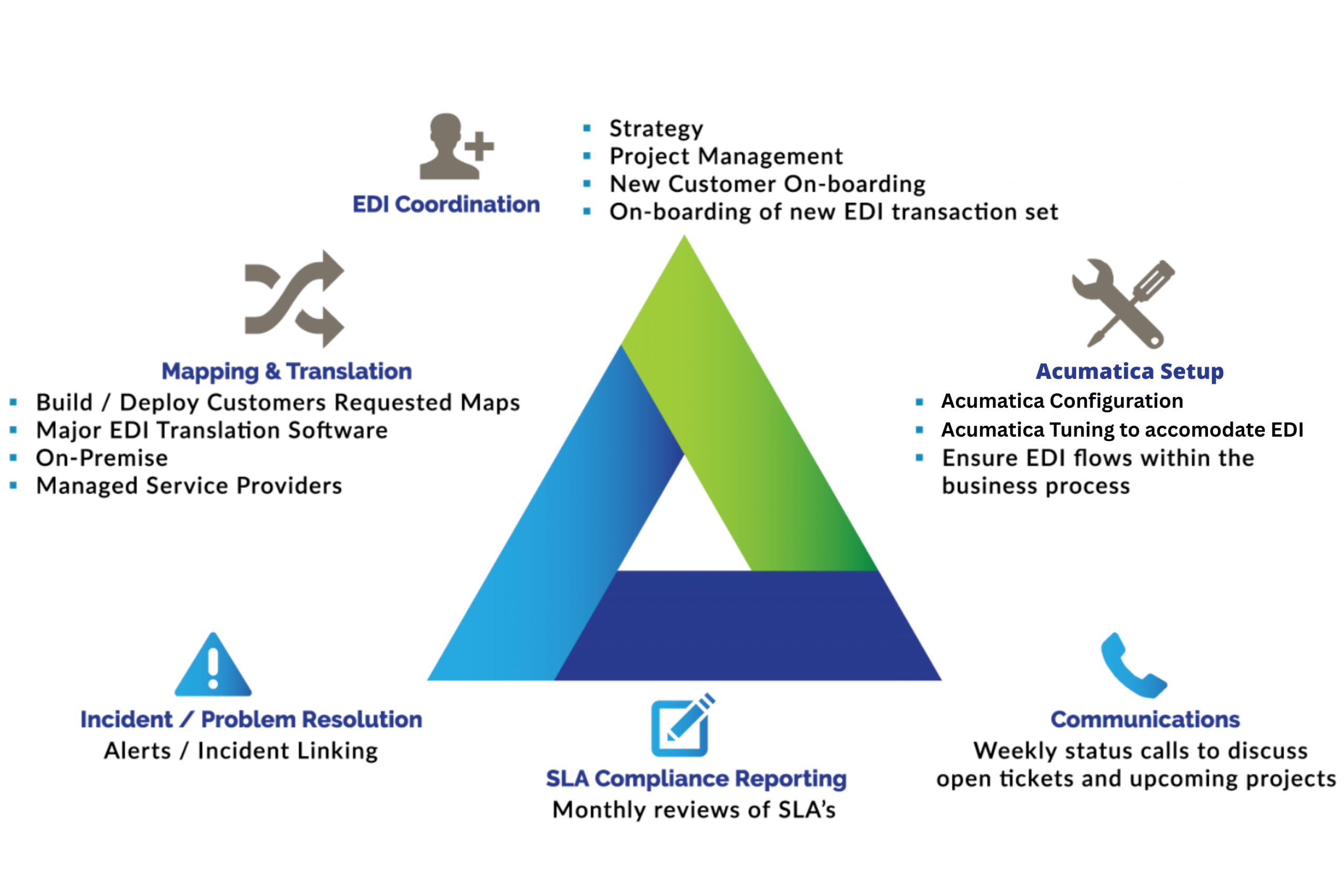
C&A Technology's EDI Managed Services for Acumatica cover the full scope of that work:
-
- EDI Coordination : Strategy, project management, new customer on-boarding, and on-boarding of new EDI transaction sets.
-
- Mapping & Translation: Building and deploying customer-requested maps across major EDI translation software, on-premise systems, and managed service providers.
-
- Acumatica Setup: Acumatica configuration and tuning to accommodate EDI, ensuring it flows correctly within the broader distribution business process.
-
- Incident & Problem Resolution: Alerts and incident linking so a failed transaction gets caught and fixed before it holds up a customer order.
-
- SLA Compliance Reporting: Monthly reviews of SLA performance.
-
- Communications: Weekly status calls covering open tickets and upcoming projects.
The practical payoff for a distributor: a customer PO that fails to map gets caught and fixed the same day instead of surfacing as a late shipment, pricing and quantity data stays accurate on the accounts that matter most, and purchasing and customer service teams spend a lot less time keying in what should have transferred automatically.
Common Mistakes Distributors Make with ERP Transformation
-
- Treating it as an IT project instead of a business transformation.ERP success depends on operations, finance, and warehouse leadership being involved from day one, not just IT.
-
- Over-customizing instead of configuring. Heavy customization increases cost, slows future upgrades, and often re-creates the same rigidity distributors were trying to escape.
-
- Migrating dirty data.Moving inaccurate inventory or pricing data into a new system just gives you the same problems with a nicer interface.
- Skipping change management.Warehouse and customer service staff need training and a clear "why," not just new login credentials.
- Ignoring EDI and eCommerce until after go-live.These are core to how distributors do business today, not optional add-ons to bolt on later.
Best Practices For Getting the Most Out of Acumatica Cloud ERP
-
- Start with a clean data foundation. Audit item masters, customer records, and pricing before migration, not after.
-
- Sequence AI adoption deliberately. Get core transactional data flowing accurately first; forecasting and automation are only as good as the data underneath them.
-
- Treat EDI as core infrastructure: not a bolt-on integration, especially if you serve big-box or major retail trading partners with strict compliance requirements.
-
- Give warehouse teams mobile tools from day onerather than phasing them in later, this is where adoption resistance is highest if the old process feels faster.
-
- Revisit configuration annually. Distribution businesses change; reorder points, warehouse rules, and reporting should be reviewed, not set once and forgotten.

Why B2B Distributors Choose C&A Technology
Selecting the right ERP is only part of a successful transformation. Implementation expertise, industry knowledge, and long-term support determine the ultimate business value.
C&A Technology brings decades of ERP consulting experience across distribution, manufacturing, supply chain, and digital transformation. Our team helps organizations modernize legacy ERP environments, reduce implementation risk, optimize business processes, integrate best-of-breed applications, enable AI-driven workflows, and deliver long-term managed services. We focus on measurable business outcomes, not simply software implementation.
FAQs - Acumatica Cloud ERP for B2B Distributors
Key Takeaways
- Acumatica Cloud ERP for B2B distributors unifies inventory, purchasing, warehousing, finance, and EDI into one real-time system, eliminating the manual hand-offs that cause errors and delays.
- Distributors implementing modern Acumatica cloud ERP see measurable reductions in inventory carrying costs by eliminating excess safety stock they didn't actually need.
- AI-enabled ERP delivers measurable gains in forecasting accuracy and operational costs, benefits legacy systems simply can't replicate.
- Self-service is now the baseline expectation for B2B buyers, not a differentiator, most B2B organizations already offer a self-service portal.
- Successful implementations configure rather than customize, prioritize clean data migration, and treat EDI and eCommerce as core infrastructure.
- Acumatica supports mixed business models, distribution, light manufacturing, field service, and retail, from a single platform.
- Implementation partner expertise, not just software selection, determines long-term ROI.
Continue the Conversation
B2B distribution is evolving faster than most legacy ERP systems can follow. Success now depends on real-time visibility, intelligent automation, connected operations, and the ability to scale without a rip-and-replace every few years.
Acumatica Cloud ERP for B2B distributors provides that modern foundation: streamlined operations, better customer service, optimized inventory, and a real path to AI-driven transformation. Combined with C&A Technology's ERP expertise, managed services, AI workshops, digital commerce capabilities, and CAT EDI solutions, distributors gain far more than a software implementation, they gain a long-term technology partner focused on measurable business value.
Ready to see what this looks like for your business? Book a Consultation with C&A Technology
Get a straight-talk assessment of where your current systems are costing you time, accuracy, or revenue, and a clear picture of what a modern cloud ERP platform would look like for your specific operation.
Book a Meeting
Related Articles
Acumatica Cloud ERP for Retail Commerce: Key Benefits from C&A Technology
The Key Benefits of Acumatica Cloud ERP For B2B Distributors: A Guide From C&A Technology

The Key Advantages of Acumatica Cloud ERP for Discrete Manufacturers: A Deep Dive with C&A Technology
What are the key benefits of using CAT’s Dual–Layer Managed Services for Acumatica Cloud ERP Systems?

Follow us online


