
C&A Technology: Cleo EDI Managed Services Partner for Acumatica, SAP & JDE
One Partner. One EDI Strategy. End-to-End Execution and Support.
Overview video »

Schedule Your JDE EDI Assessment
Complete the form below or call
(844) 533-4228 to get started with our service and products
Where EDI Breaks Down
Whether you run Acumatica, SAP, or JD Edwards, EDI challenges tend to look remarkably similar: slow trading partner onboarding, recurring exceptions, fragmented support responsibilities, and limited visibility until something goes wrong.
The issue is usually fragmentation. EDI can evolve into a collection of separate technologies, trading partner connections, maps, ERP interfaces, and support responsibilities managed by different people or different vendors. When a transaction fails, the first question can become:
- Is it the trading partner?
- The EDI map?
- The Cleo integration process?
- The ERP interface?
- Or the underlying business transaction?
That diagnostic delay can be one of the most expensive parts of an EDI failure, and it's rarely about which ERP is involved.
What CAT's EDI Managed Service Using Cleo Platform Can Change

The case for a managed EDI model isn't just fewer support tickets,it shows up in the numbers your business already tracks: onboarding speed, order accuracy, IT capacity, and cost. Below is where customers running Acumatica, SAP, or JD Edwards typically see the difference first.
- Accelerate trading partner onboarding — standardized onboarding processes and dedicated coordination shorten the time between signing a new trading partner and moving live transactions
- Reduce EDI errors & exceptions — disciplined mapping, testing, and exception management catch problems before they reach production or a trading partner
- Increase order accuracy & on-time delivery — cleaner data moving through the ERP means fewer downstream fulfillment and invoicing errors
- Free internal IT resources for strategic ERP initiatives — your team stops fielding day-to-day EDI tickets and gets back time for ERP upgrades, projects, and roadmap work
- Reduce costs tied to manual reconciliation and compliance penalties — fewer manual corrections and fewer missed trading partner requirements means fewer chargebacks and less rework
Built for Every ERP: Acumatica. SAP. JD Edwards. One Model, Adapted to Each
Acumatica - Organizations can be a particularly strong fit for this model. Companies choosing Acumatica are frequently looking beyond a simple accounting system replacement; they're building a cloud ERP platform to support growth across distribution, manufacturing, B2B commerce, retail commerce, and increasingly complex supply chains. Acumatica's cloud-native, API-driven architecture changes how EDI can connect with the ERP compared with traditional on-premise environments, and Cleo's Application Connector for Acumatica ERP further supports that connection. For new Acumatica customers, EDI can be designed into the overall ERP strategy from the beginning. For existing Acumatica customers, CAT can help modernize EDI without requiring a change to the underlying ERP strategy.
SAP - EDI transactions commonly interact with SAP through IDocs (Intermediate Documents) and the ALE (Application Link Enabling) layer. Successful integration requires an understanding of SAP's IDoc structures, partner profiles, message types, functional configuration, and exception processing. CAT's SAP EDI managed services combine this SAP knowledge with EDI coordination, mapping and translation, Cleo platform support, and centralized issue management with the goal of reliable transaction processing, clear accountability, proactive exception management, and visibility across the complete EDI process.
JD Edwards - EDI documents are commonly processed through the JD Edwards F47 interface tables. Inbound transactions such as purchase orders enter the interface tables before being processed into JD Edwards applications, while outbound transactions such as ASNs and invoices follow the corresponding outbound process. This architecture is proven and well understood, but it requires specific knowledge of JD Edwards EDI configuration, System 47, batch processing, and the associated business applications. CAT combines that JD Edwards expertise with Cleo-based translation, monitoring, trading partner management, and ongoing support adding modern visibility and managed services around a proven ERP environment without disrupting the underlying business applications.
If your company runs more than one of these ERPs, following a merger, an acquisition, or a multi-division rollout, CAT can provide EDI continuity across all of them rather than a separate strategy for each.
CAT's Four-Pillar EDI Managed Services Model
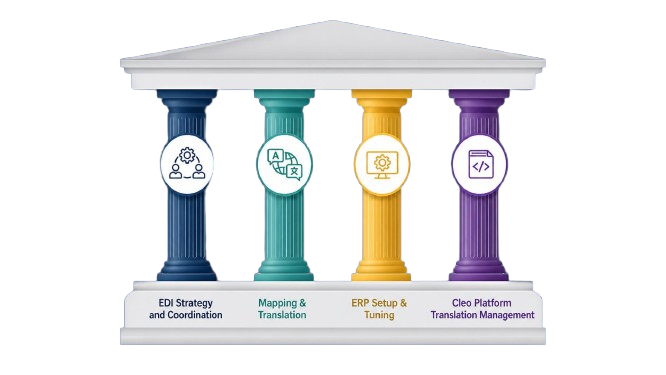

EDI Coordination
Someone needs to own the trading partner relationship, managing communication, requirement changes, transaction failures, and exceptions.Clear ownership keeps EDI operations moving and issues resolved quickly.
- End-to-end coordination across your trading partner network
- Direct communication and issue resolution when problems arise
- Disciplined exception management so nothing sits unresolved in a queue

EDI Mapping & Translation
Behind every clean transaction is a map that was built correctly and maintained as requirements change.
- Work with major EDI translation software
- EDI Direct implementation through integration brokers
- Flexible deployment, on-premise or cloud, depending on what fits your environment
- Ongoing map maintenance with proper version control, so a trading partner's spec change doesn't turn into a production issue

JDE Setup & Tuning
This is where most generalist EDI providers fall short: EDI only works if System 47 is configured correctly underneath it.
- JDE configuration within System 47
- Management of the tables, codes, and relationships EDI depends on
- Workflows and business rules that connect transactions to your actual business processes
- Security and access management
- Performance and stability tuning, because a slow or unstable JDE environment will surface as an EDI problem even when the map is perfect

Cleo Platform Management
CAT provides full ownership of the Cleo Enterprise EDI Platform, with 24x7 monitoring and direct access to Cleo infrastructure.
- Full platform ownership on the Cleo Enterprise EDI Platform, monitored 24x7
- Active management of trading partner communications
- Infrastructure built for high availability and redundancy
- Performance and capacity management
- Scheduled software updates and maintenance
- Security and compliance, so the platform itself is never the reason a transaction fails
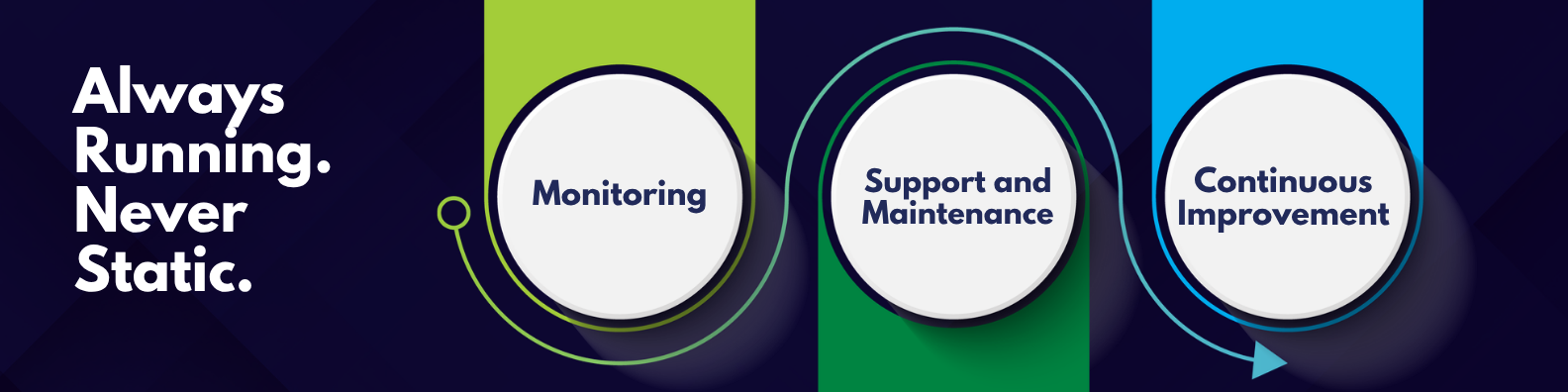
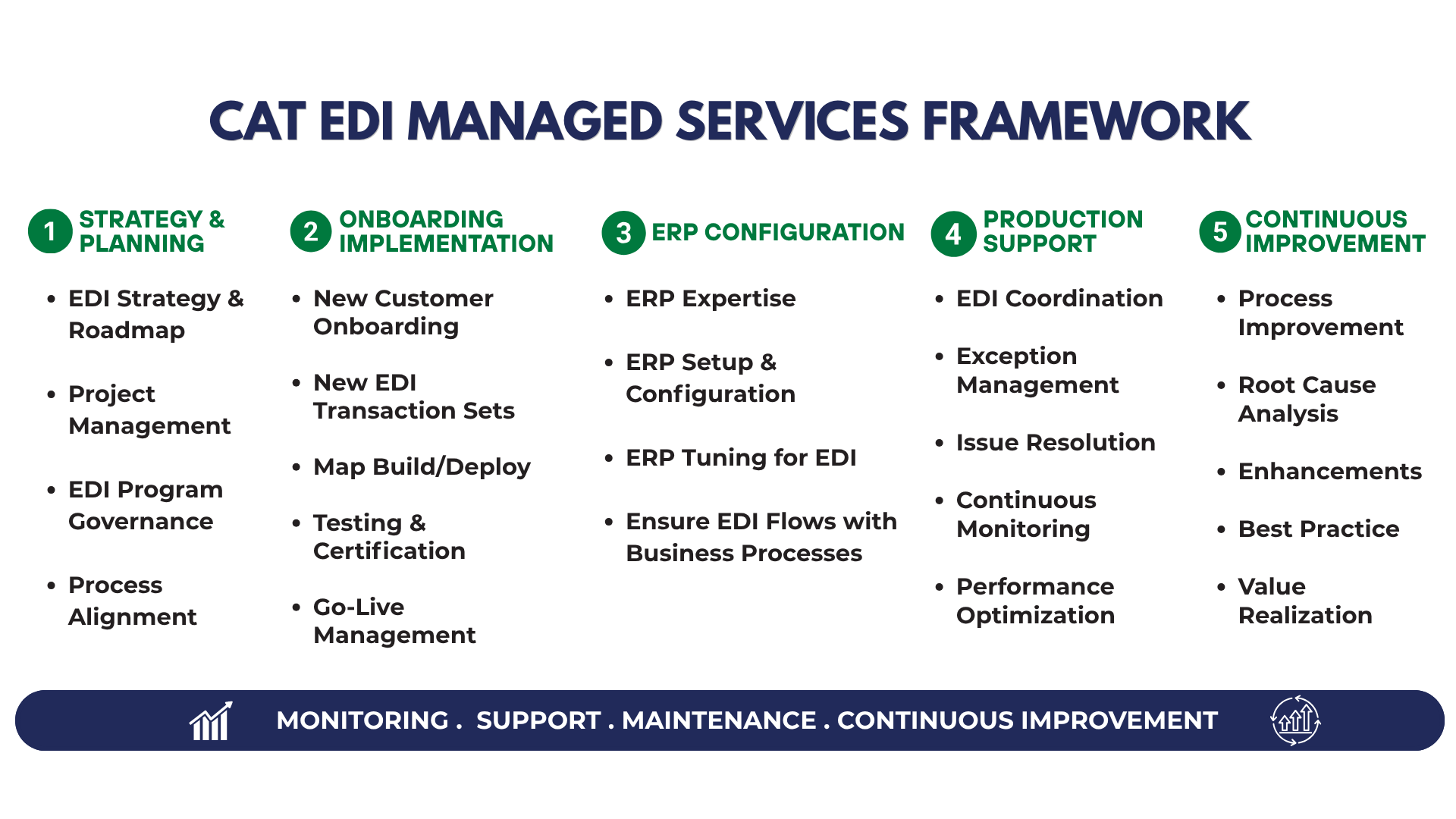
CAT EDI Managed Services Framework
Centralized Jira Enterprise Support Desk
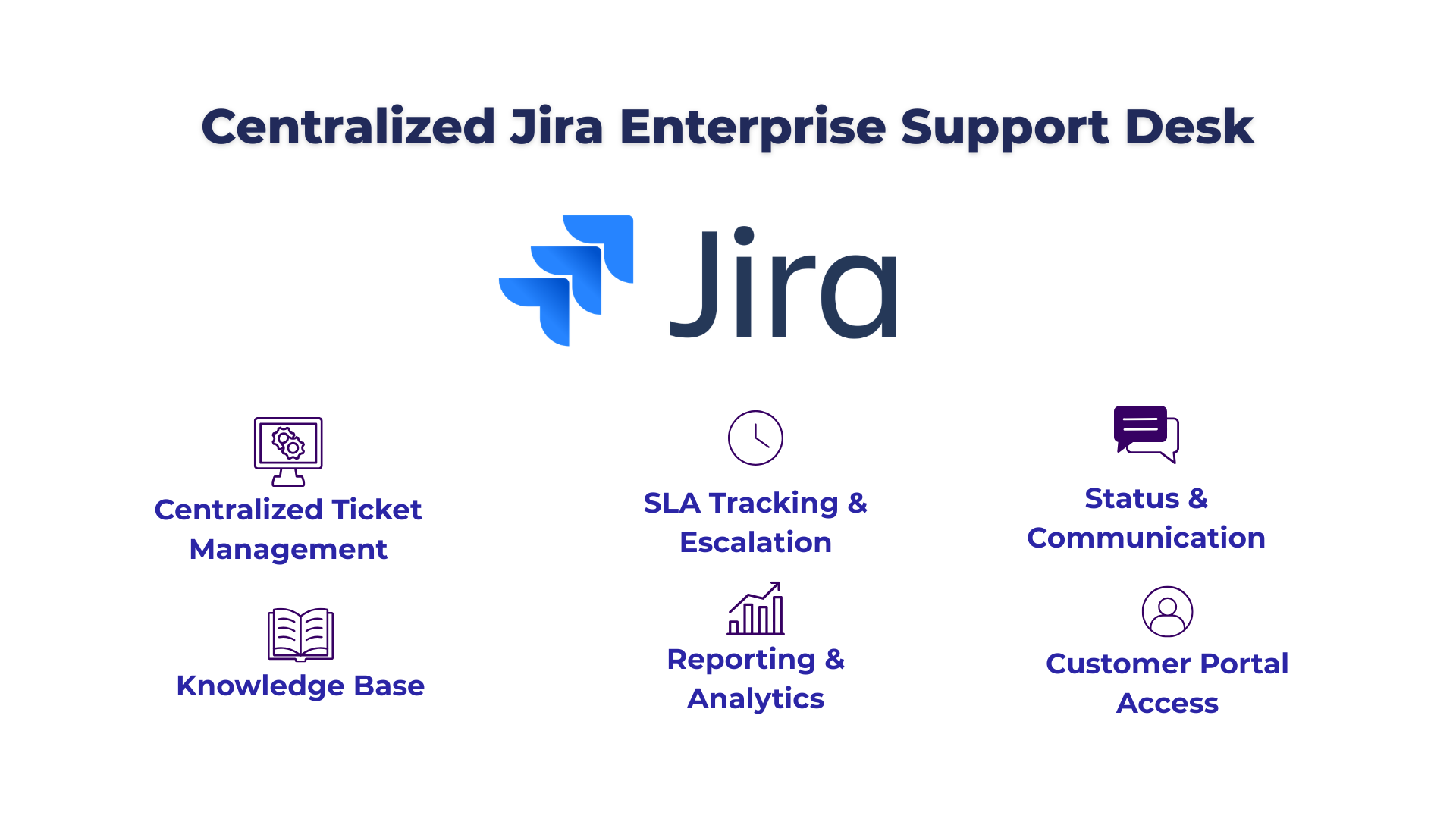
When something goes wrong, you shouldn't have to figure out who to call. Every issue — whether it's a trading partner exception, a mapping question, or a JD Edwards, SAP, or Acumatica configuration problem, comes into the same enterprise support desk, tracked and owned until it's resolved.
- Centralized ticket management (Jira-based) — one intake point for every issue, regardless of which part of the environment it touches
- SLA tracking & escalation — defined response and resolution targets, with automatic escalation if they're at risk
- Status & communication — visibility into where an issue stands without having to chase an update
- Knowledge base — documented fixes and configuration history so recurring issues get resolved faster
- Reporting & analytics — ticket volume, resolution time, and exception trends reviewed on a regular cadence
- Customer portal access — direct visibility into open tickets, history, and status at any time
Full EDI Transaction Support
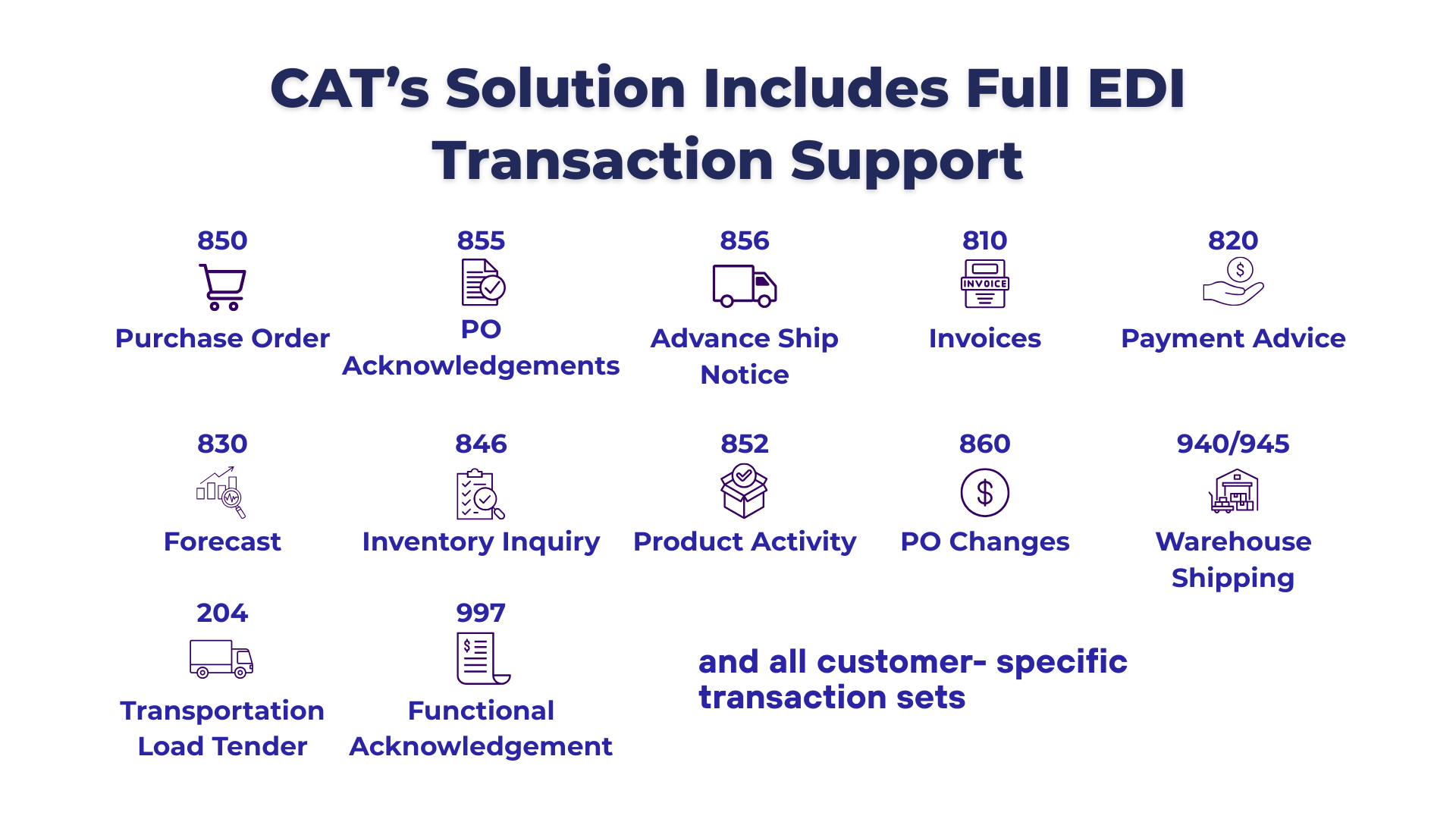
Trading partners don't limit themselves to one or two document types, and neither does CAT's support. Whether a transaction originates through an Acumatica API, an SAP IDoc, or a JD Edwards F47 interface table, it runs through the same Cleo platform and the same managed services model on the way to your ERP.
- Order & Fulfillment 850 Purchase Order · 855 PO Acknowledgment · 860 PO Change · 856 Advance Ship Notice · 940/945 Warehouse Shipping · 204 Transportation Load Tender
- Financial 810 Invoice · 820 Payment Advice
- Planning & Inventory 830 Forecast · 846 Inventory Inquiry · 852 Product Activity
- Acknowledgments 997 Functional Acknowledgment
Plus every customer-specific transaction set your trading partners require, if it needs to move between a trading partner and your ERP, it's in scope.
Two Ways to Get CAT EDI Support Delivery Options
Not every organization needs the same level of support, so we offer two delivery models, and you can move between them as your needs change.
- On-Demand Support: For teams that want expert help available without a full managed services commitment: project work, expert assistance when you need it, small enhancements, issue resolution, advisory and consulting, and flexible engagement terms that scale with your workload.
- Fully Managed Services: For organizations that want EDI fully off their plate: end-to-end ownership of the environment, 24x7 monitoring, daily operations management, formal SLA management, proactive issue prevention before problems reach production, and monthly reporting and reviews to keep the engagement aligned with your goals.
The Cleo Ecosystem Enablement Maturity Model
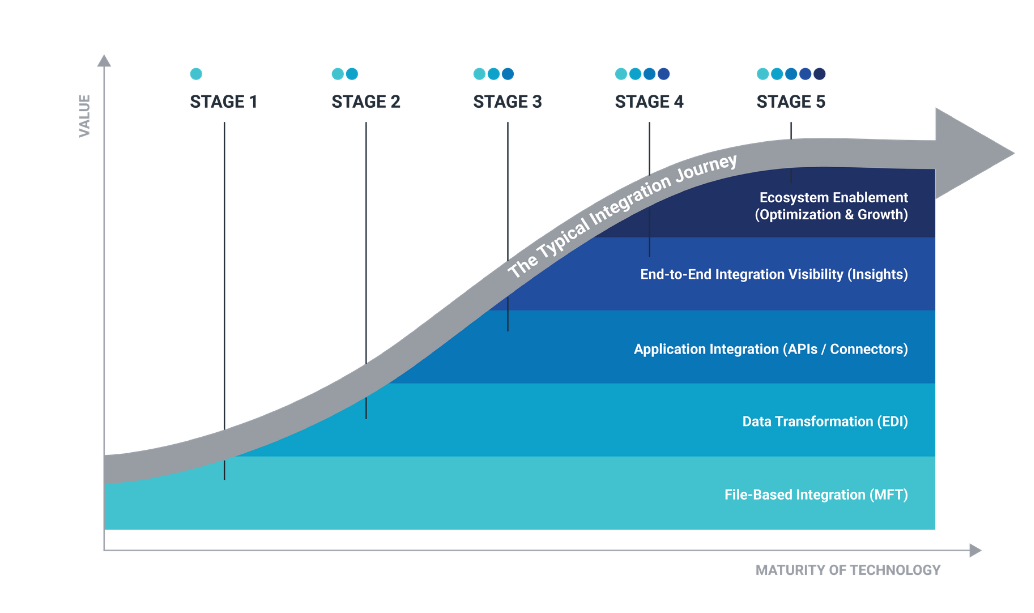
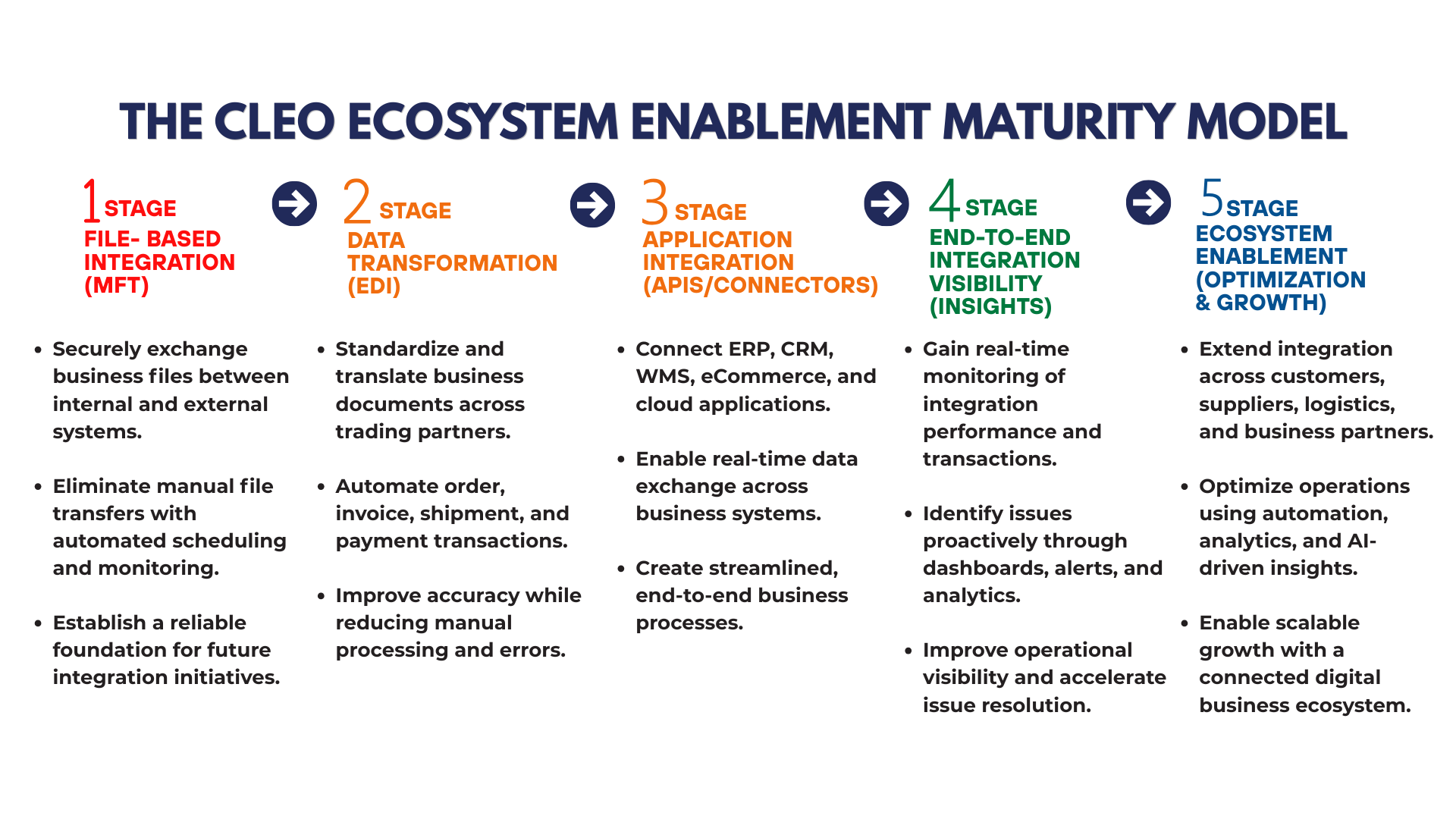
The roadmap above is about how well your EDI operation runs today. This model is about how far your Cleo footprint can grow. Most organizations adopt Cleo Integration Cloud in stages — starting with basic file exchange and building, over time, toward a fully connected ecosystem across ERP, CRM, WMS, and trading partner systems. CAT helps customers identify which stage they're in today and what the next one requires, independent of which ERP sits at the center.
- Stage 1 — File-Based Integration (MFT)
- Stage 2 — Data Transformation (EDI)
- Stage 3 — Application Integration (APIs/Connectors)
- Stage 4 — End-to-End Integration Visibility (Insights)
- Stage 5 — Ecosystem Enablement (Optimization & Growth)
Not Sure Where You Stand? Start With the EDI Bootcamp
Not sure where your EDI environment stands today? Start with an assessment.
Our EDI Bootcamp gives you a clear, documented view of your current state: a full current state assessment, a combined process and technical review, gap analysis against best practices, and specific recommendations for closing those gaps. You leave with a prioritized roadmap and a business case and ROI model, so any investment decision that follows is based on evidence, not guesswork.