October 6, 2026
AI Starts with Data, Not AI: How to Get Your JD Edwards Data AI-Ready
tl;dr of Why AI Projects Fail on JD Edwards Data
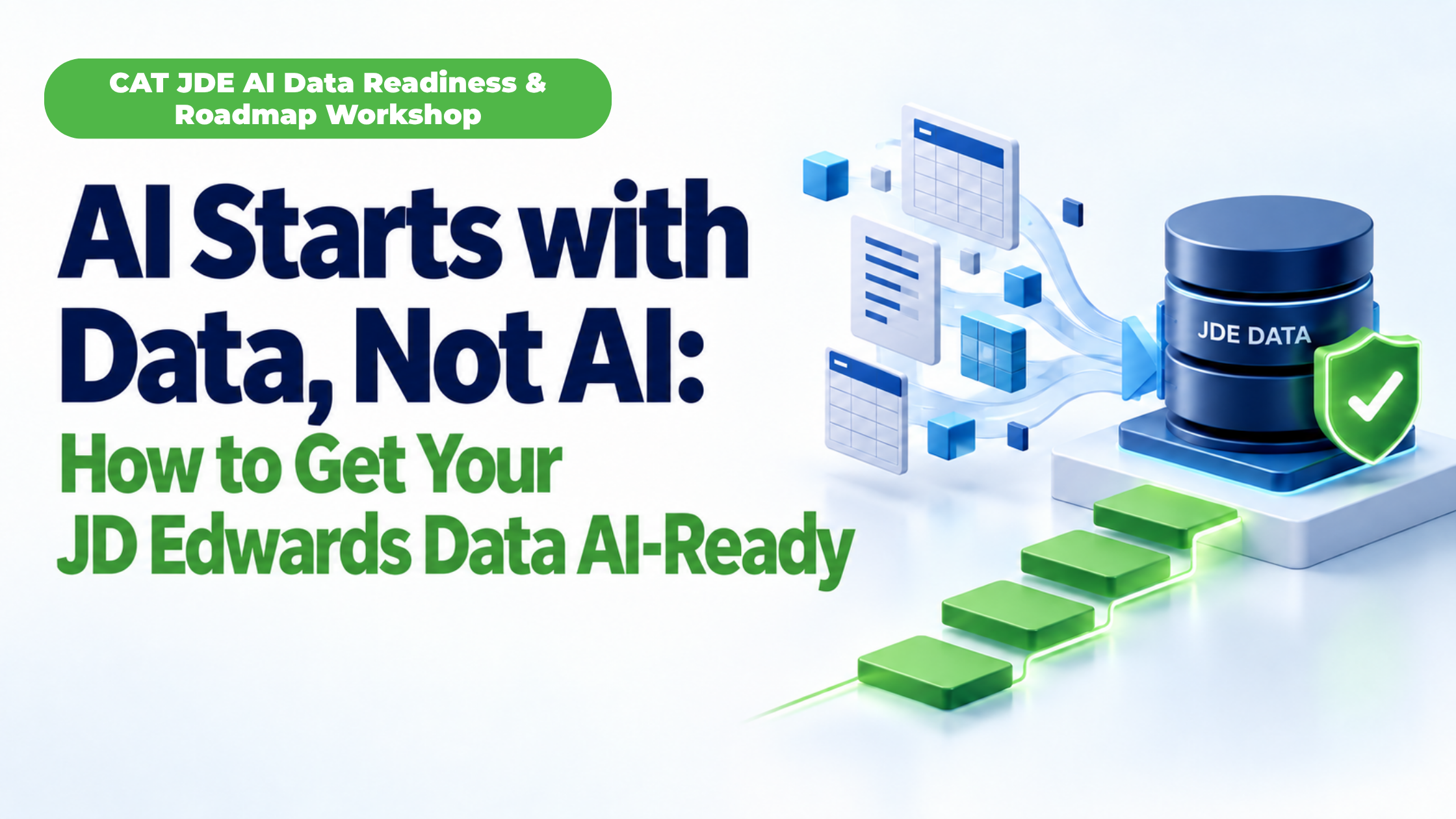
AI starts with data, not AI. AI projects on JD Edwards stall when the data underneath is not authoritative, consistently defined, connected, or governed, no matter which AI platform you choose. That is why CAT's workshop is an AI data readiness assessment: in about 40 hours over 3 to 4 weeks, it finds the gaps and turns them into a prioritized roadmap.
The fix in three parts: agree on a source of truth and shared definitions, assess your data against the six readiness dimensions, then prioritize use cases and build a roadmap. The rest of this article shows how.
Let's talk about CAT's JDE AI Data Readiness & Roadmap Workshop
AI starts with data, not AI. Most conversations begin with "Which AI platform should we use?" or "What agents should we build?" For JD Edwards organizations, the better first question is whether AI can reliably access and understand the information needed to answer the business question.
AI is only as reliable as the data behind it. To deliver trusted answers, it needs to know which data is authoritative, what it means, how current it is, who owns it and whether it can be trusted. Get that foundation right and AI can deliver real business value. That is why CAT built its JDE workshop as an AI data readiness assessment: it makes the data trusted, accessible and governed first, then builds a practical roadmap for turning that data into insights, automation and business value.
Gartner's research shows how common this is. In a July 2024 survey of 1,203 data management leaders, 63% of organizations said they either lack or are unsure they have the right data management practices for AI. Gartner also predicted that 60% of AI projects unsupported by AI-ready data would be abandoned through 2026
For JD Edwards teams, that is both a warning and an opportunity. You have years of business data in JDE. The question is whether AI can use it with confidence. This article explains why pilots stall, and how CAT's JDE AI workshop turns the gaps into a practical roadmap.
The Question That Stalls the Pilot
It sounds like a simple question. Ask it of a traditional report and you get a predefined answer. Someone has already decided which tables to use, which fields matter, how calculations work and which filters apply.
Ask it of AI and that same question may require financials, sales, customers, products, pricing, manufacturing, inventory and historical information. AI has to interpret all of it, and make those decisions itself.
That is where pilots stall. The first answer does not match the finance report. Someone asks why. Nobody can say which source AI used, or whether it should have.

Why AI Changes the Data Requirement
A report is built. AI is asked. That difference raises the bar in seven places:
- Context: AI must understand what tables, fields, and codes mean.
- Data quality: Errors and gaps flow straight into answers.
- Definitions: Terms must mean the same thing across teams.
- Security: Broader questions touch broader data, so access has to be explicit.
- Relationships: AI must connect customers, orders, items, and invoices correctly.
- History: Many questions need trend data, not just current data.
- Governance: Someone must own the rules.
None of these were new problems. Reports simply hid them. AI exposes them.

Your Data Doesn't Live Only in JD Edwards
Over years of operation, JDE environments naturally grow an ecosystem around them: reporting tools, data warehouses, spreadsheets, EDI, APIs, e-commerce, CRM and custom applications. Each one holds some of the truth.
For AI to deliver trusted results, your organization needs to be able to answer six questions about any piece of data:
- Which data is authoritative?
- What does it mean?
- How current is it?
- Who owns it?
- Who can access it?
- Can it be trusted?
If a pilot cannot answer these, it cannot produce answers your leaders will rely on.

The Six Dimensions of AI-Ready JDE Data, and the Gaps to Look For
Here is how each dimension of AI-ready data shows up as a failure in practice. This is the extension of the framework on our workshop page, where the full approach is explained.
- Accessible: AI can't reach the data
The question: Can authorized AI services securely reach the required information?
The gap to look for: Key information sits in spreadsheets, a legacy reporting database, or an integration nobody documented. The pilot answers from the part of the picture it could reach.
- Trusted: The data isn't accurate or complete enough
The question: Is the underlying information sufficiently accurate and complete?
The gap to look for: Duplicate records and gaps that people work around manually become wrong answers when AI reads them literally.
- Consistent: Teams define terms differently
The question: Do finance, operations, sales, and other functions use the same definitions?
The gap to look for: "Margin," "customer," and "on-time" mean different things in different departments. AI compares across them and produces numbers that look wrong to everyone.
- Contextualized: AI can't understand what the data means
The question: Can the business meaning behind JDE tables, fields, codes, and relationships be understood?
The gap to look for: JDE codes that only a long-time user understands are meaningless to AI without documentation of what they represent and how records relate.
- Governed: Nobody has defined the rules
The question: Are ownership, permissions, security, and acceptable AI usage defined?
The gap to look for: The pilot stalls at the first sensitive request, or proceeds without guardrails.
- Timely: The data isn't fresh enough for the use case
The question: Is information available at the frequency required?
The gap to look for: A nightly feed supports a monthly report but not a same-day decision. Readiness depends on the use case.
A single weak dimension can undermine an otherwise strong pilot, which is why CAT assesses all six for every priority use case.

AI Starts with Data, Not AI: Why Starting with the Platform Makes It Worse
This is the idea behind CAT's workshop. Trusted data is the foundation for meaningful AI outcomes. Without accurate, connected and governed data, AI cannot deliver reliable business value, however good the platform is.
When a pilot disappoints, the instinct is to blame the tool and try another. If the problem is the foundation, the next tool inherits it.
There is a second cost. Early platform decisions lock in architecture before you know your data gaps. Gartner's guidance makes a similar point: AI-ready data is "not one and done," but a practice that requires constant improvement based on current and upcoming use cases.
CAT's approach reverses the order. Establish trusted, governed data and a clear business purpose first. Then let your needs and data readiness guide technology decisions, including data warehouse or lakehouse design, platform and tooling selection, and governance foundations.
How to Fix It: From Frustration to Roadmap
-
CAT's workshop follows five steps: Listen → Align → Assess → Chart → Enable. In practice, here is how it works:
Step 1: 1:1 leadership interviews (30 to 45 minutes each). In the one to two weeks before the workshop, CAT talks with executive sponsors, a CIO or technology lead, a JD Edwards functional director, a development director, and a data or reporting lead, plus people such as a finance power user or an e-commerce lead. CAT listens for business goals over the past and next three years, ideas where AI could save time or make money, concerns about accuracy, security, cost, and change, where reporting is not trusted, who should own access, and what will make adoption succeed or fail.
Step 2: The half-day workshop (about 3.5 to 4 hours, 6 to 8 people). The agenda moves from the problem to priorities:
- Welcome and framing: Each person names their number-one data frustration.
- Module 1, AI demystified: What MCP, RAG, agents, automation, and testing mean, each tied to a real JDE example, plus what is realistic for AI with JD Edwards versus hype.
- Module 2, use-case prioritization: Brainstorm by function, then plot ideas on a value versus effort grid.
- Module 3, data foundation and roadmap: Why a trusted data foundation comes first and how it fits your JD Edwards plans.
- Wrap and commitments: Recap decisions, the Wave 1 list, and agreed actions.
Step 3: Current-state assessment. Run in parallel with interviews, it reviews data sources, domains and ownership, dependencies and integrations, and quality and trust gaps.
The engagement is approximately 40 hours over 3 to 4 weeks. It is a focused advisory assessment that grounds the roadmap, not a deep technical audit.

What You Walk Away With
At the close of the engagement you receive:
| Deliverable | What it contains |
|---|---|
| Voice-of-leadership synthesis | Every leader's goals, ideas and concerns, non-attributed and tied to a business objective |
| Prioritized use-case portfolio | Ranked use cases with value, data readiness and effort, organized into waves |
| Current-state assessment | Data sources, domains and ownership, dependencies and integrations, quality and trust gaps |
| AI-ready architecture direction | Single-source-of-truth design direction, governed by testable AI-readiness success criteria |
| Governance starter framework | Data ownership, access and security, quality, AI-use principles, testing and validation, oversight |
| Roadmap and milestones | Phased plan sequencing the data warehouse, OCI migration and JDE upgrade |
| Next-phase proposal outline | A one-page proposal or SOW outline for the build phase |
Success also has three plain-language checks: leaders can explain what practical AI is and isn't, the group has a ranked short list of use cases tied to money made or saved (the Wave 1 candidates), and everyone agrees the current-state assessment plus an AI-ready data roadmap is the right next move.
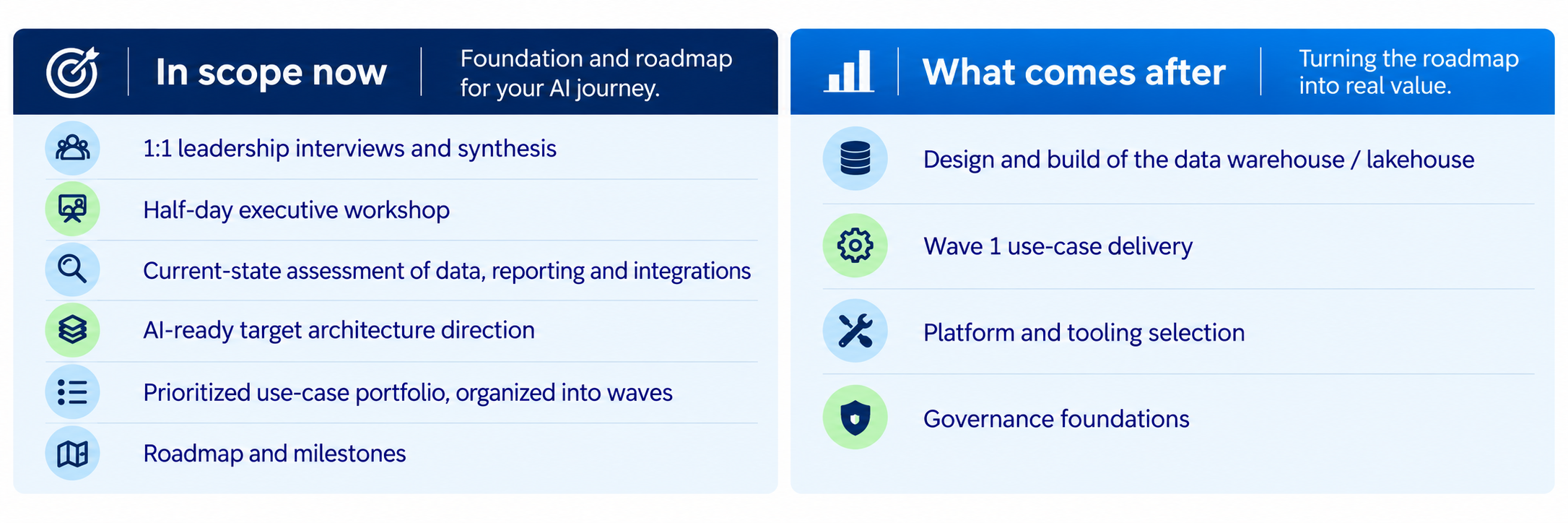
Building comes after. In scope now: the foundation and roadmap. What comes next: designing and building the data warehouse or lakehouse, delivering the Wave 1 use case, selecting platforms and tooling, and putting governance foundations in place.

How to Prepare with C&A Technology
Preparation makes every session count. CAT asks for:
- People and time: 30 to 45 minutes per interview participant, 3.5 to 4 hours for the leadership group on workshop day, short working sessions with system owners, and one named JDE owner for scheduling and data access.
- Before the workshop: Confirm attendees, date and room, and ask each function leader to bring one or two reporting frustrations and their business impact.
- For the assessment: Read access to representative data and reports, existing documentation, and visibility into integration points, including the nightly JDE feed to the website.
For more preparation guidance, download the 10 Best Practices of CAT's AI Workshop for JD Edwards from the workshop page.

Key Takeaways
- AI answers questions; reports follow rules. That's why gaps that reports hid now show up.
- Know your six data questions: authoritative, meaning, current, owner, access, trust.
- Each readiness dimension is also a failure mode. Assess all six per use case.
- Don't pick the platform first. Let business needs and data readiness guide technology.
- A 3 to 4 week workshop produces a roadmap. Prioritized use cases, current-state assessment, governance starter and phased plan.
- Bring real frustrations. They keep the work practical.
Conclusion
AI starts with data, not AI. A stalled pilot is useful information: it shows where your data, definitions and decisions are not yet aligned. The teams that move past it start with trusted data and a clear business purpose, then choose the technology. That is exactly what an AI data readiness assessment is for.
If you want to know where your gaps are, don't guess. Register for the workshop, bring your real frustrations and leave with a roadmap.
Book a Meeting
Related Articles



Follow us online