June 8, 2026
What Are the Real Risks of SAP S/4HANA Migration and How KTern.AI with C&A Technology Resolves It
The Real Risks of SAP S/4HANA Migration
TL;DR for SAP S4HANA Migration Risks
The SAP®S/4HANA migration carries four compounding risks: data integrity failures, custom code obsolescence, testing blind spots, and project overruns, and most organizations don't discover them until they're already paying for them.
C&A Technology, in partnership with KTern.AI's Agentic AI platform, resolves each of these risks through autonomous process mining, intelligent code remediation, risk-based testing, and real-time governance.
This blog breaks down exactly where S/4HANA transformations fail and what a modern, AI-driven approach looks like in practice.
If your SAP S/4HANA AI migration assessment hasn’t started yet, now is the right time to establish clarity before timelines tighten. Talk to our C&A Technology SAP S/4HANA AI expert today.
What's the Real Risk of SAP S/4HANA migration and How Does AI Actually Fix It?
SAP S/4HANA implementation risks are real, well-documented, and increasingly costly in 2026. And with SAP ECC mainstream support ending in 2027, the organizations that wait are now running out of runway.
C&A Technology (CAT), in partnership with KTern.AI, a specialized Agentic AI platform built exclusively for SAP transformations, has developed an AI Acceleration Framework that directly addresses each layer of S/4HANA implementation risk. We will see exactly what those risks are, where they compound, and how AI resolves them before they become crises.
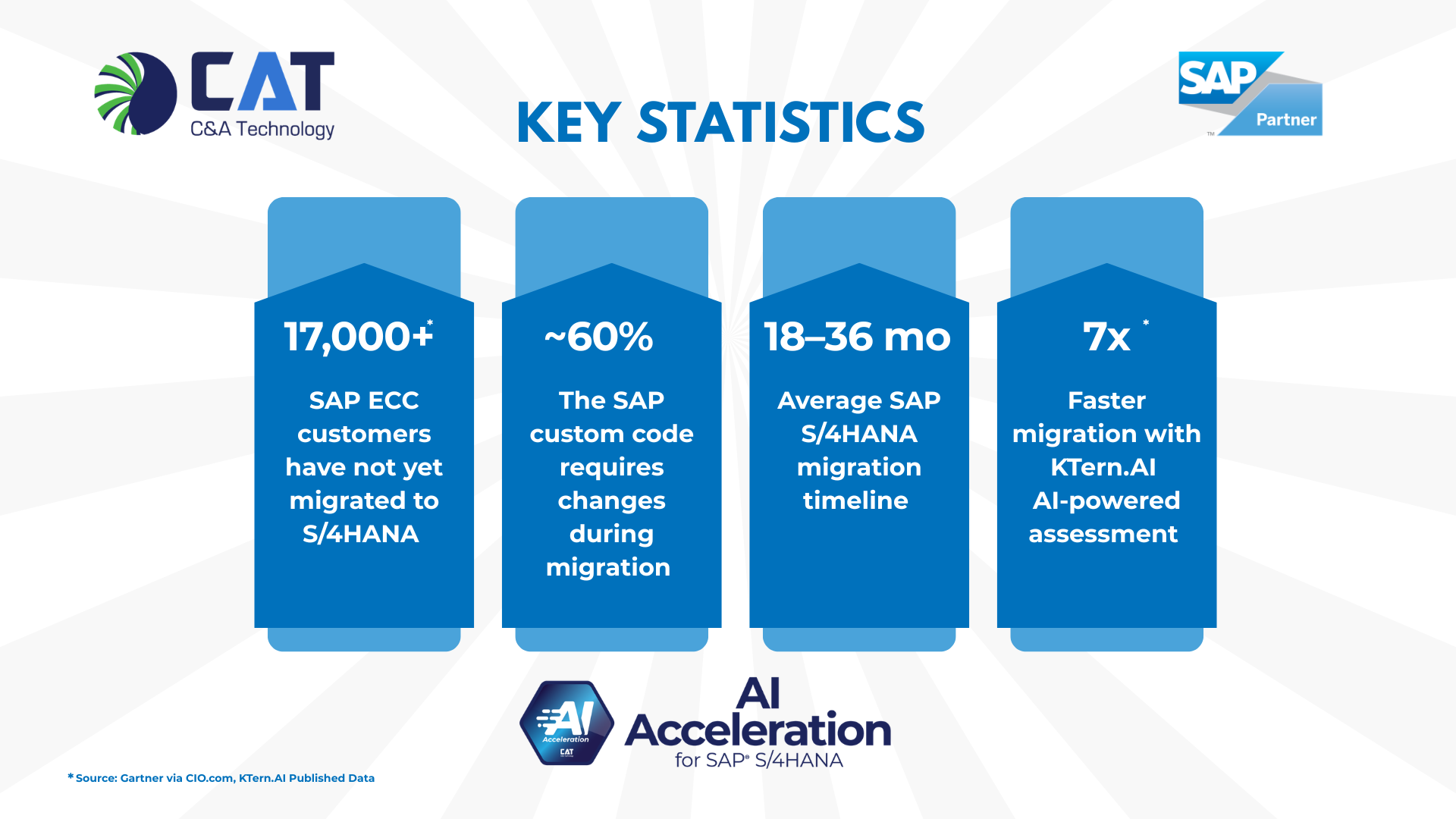
Stat Sources:
Risk 1: Data Integrity and Migration Failure
"Data migration usually starts too late and becomes the major bottleneck at go-live." - SAP Community
Most SAP teams underestimate data until it's too late. The promise of a clean, unified system going live on day one quietly falls apart when it becomes clear just how much legacy data is inconsistent, orphaned, or structurally incompatible with S/4HANA's simplified data model.
What this risk looks like in practice:
- Master data records that reference objects that no longer exist in the new system
- Inconsistent financial data from years of manual entries and workarounds
- Unmapped fields between source and target systems that get silently dropped
- Integration handshakes that fail because the data shape has changed
- Corrupted mapping between business partner records and vendor/customer tables
In one documented case, missing or malformed master data records caused order processing to fail entirely in production, requiring emergency data fixes and unplanned system downtime on the first week of go-live. The cost wasn't just financial, it was the trust of the organization's largest customer.
Why it happens: Teams typically scope data migration as a technical task rather than a business-critical program. Discovery starts late, cleansing is underestimated, and reconciliation is treated as something that can be resolved after go-live. It cannot.
Risk 2: Custom Code Breakage and Clean Core Conflict
If data migration is the visible risk, custom code breakage is the hidden one, because it doesn't announce itself until you're deep into the project.
Organizations that have been running SAP ECC for a decade or more have accumulated thousands of custom ABAP programs, user exits, BADIs, and Z-objects. These were written to solve real business problems. They worked. And now they are potentially incompatible with S/4HANA's clean core architecture, which fundamentally changes how data is stored, how the Universal Journal works, and how extensions must be built.
What this risk looks like in practice:
- Legacy ABAP code that directly reads or writes to tables that have been deprecated or restructured in S/4HANA
- Business-critical customizations that can no longer run as-is and require complete redesign
- Extended timeline and cost as development teams manually review, test, and remediate thousands of objects
- Scope creep when teams discover new incompatibilities during testing rather than in the assessment phase
- Post-go-live performance degradation when undetected code conflicts surface under production load
SAP's clean core strategy is not optional in S/4HANA, it is architectural. Custom code that directly modifies standard SAP tables, that bypasses the new extensibility framework, or that relies on deprecated APIs will break. The question is whether you find it before or after go-live.

Risk 3: Testing Bottlenecks That Hide Until Go-Live
Testing is where SAP migrations are supposed to be validated. It is also where the most dangerous blind spots live.
Conventional SAP testing approaches are manual, time-intensive, and fundamentally reactive. A team can build test scripts based on what they know, but what they know is bounded by their experience, their access to documentation, and the time they have. What they don't test is what breaks in production.
What this risk looks like in practice:
- Test coverage that is broad at the surface but shallow at the process level
- High-risk business processes, payroll, procurement, order-to-cash, that receive the same test weight as low-risk ones
- Regression testing that takes weeks and still misses edge cases
- Defects discovered in production that existed in UAT but weren't caught because no one ran that specific process combination
- No traceability between test cases, defects, and business sign-off, making compliance and audit trails nearly impossible
The go-live day failure described earlier, the manufacturer whose production lines stopped, was a testing failure. The business process existed. It just hadn't been prioritized. The test case wasn't executed. And when the real production load hit a real configuration, it broke.
Risk 4: Project Overruns, Budget Blowouts, and Resource Gaps
The numbers have not meaningfully improved in recent years because the root causes haven't changed: scope creep, manual dependency, poor governance visibility, and a project model that assumes clarity that doesn't exist at the start.
What drives overruns specifically:
- Scope creep — business requirements evolve during the project without formal control, adding unplanned work at full consulting rates
- Manual dependency — key decisions live in the heads of two or three people, creating single points of failure
- No real-time visibility — project health is assessed in weekly status meetings, not continuously
- Resource shortages — demand for SAP talent is expected to reach three times the available supply by 2027
- Disconnected tools — code in one system, processes in another, testing in spreadsheets, approvals in email
The result is predictable: a project that begins with a clear scope and a confident timeline ends with an emergency steering committee and a forensic accounting exercise.
How KTern.AI's Agentic AI Resolves Each Risk
KTern.AI is not a generic AI tool or a consulting methodology. It is a specialized Agentic AI platform built exclusively for SAP transformation, migration, upgrades, and ongoing optimization. Every capability in KTern.AI was designed around the specific, recurring failure modes of SAP programs.
Here is exactly how it addresses each risk.
Autonomous Data and Process Mining → Resolves Risk 1
KTern.AI's AI agents map your "As-Is" to "To-Be" processes autonomously. Rather than relying on manually interviewing stakeholders and documenting workflows, KTern.AI reads your live SAP system, analyzing usage patterns, transaction volumes, process flows, and data structures, and builds a structured picture of what you actually have, not what the documentation says you have.
This eliminates the most common data migration failure mode: discovering data problems after scope has been locked and timelines set. KTern.AI surfaces inconsistencies, orphaned records, and structural incompatibilities during the assessment phase, when they can be planned for, not during cutover, when they cause emergency downtime.
Clean Code Modernization → Resolves Risk 2
KTern.AI's intelligent code agents scan every ABAP object in your landscape and assess compatibility with S/4HANA's clean core requirements. They identify:
- Objects that use deprecated APIs or direct table access
- Custom code that conflicts with the Universal Journal data model
- Extensions that can be replaced with standard S/4HANA functionality
- Code that needs to be refactored vs. code that should simply be retired
Beyond detection, KTern.AI's agents simulate code execution, detect vulnerabilities, and in many cases generate remediated versions automatically, turning a months-long manual ABAP review into a structured, automated, auditable workflow.
Risk-Based Testing (RBT) → Resolves Risk 3
KTern.AI applies AI to the question that conventional testing never answers well: what matters most?
Its Risk-Based Testing engine analyzes your SAP landscape to identify which business processes carry the highest operational risk. It then generates test cases automatically for those processes, prioritizes execution order, and tracks defects in real time, with full traceability from test case to business sign-off. This means high-risk processes like order-to-cash, production planning, and payroll get tested deeply and repeatedly. Low-risk, low-usage transactions don't consume the same resources. Testing becomes intelligent, not exhaustive. The result: fewer missed defects, faster test cycles, and no more discovering critical failures on go-live day because the right test case was never written.Automated Compliance and Governance → Resolves Risk 4
KTern.AI replaces disconnected project tools with a single, unified governance platform. Every phase of the transformation, assessment, design, build, testing, and cutover is tracked, documented, and made visible in real time.
Instead of weekly status meetings that report on what happened five days ago, project leadership sees live project health: what is complete, what is at risk, where consultants are spending time, and what decisions are outstanding. Sign-offs, compliance matrices, and documentation are generated automatically, not assembled manually at the end of each phase.
This eliminates the information vacuum that drives scope creep and overruns. When everyone can see the project clearly, decisions get made faster and problems get caught earlier.
C&A Technology and KTern.AI: What AI-Driven SAP Delivery Looks Like
C&A Technology brings decades of SAP delivery experience across manufacturing, supply chain, distribution, and finance. Senior architects. Industry-specific templates. Deep integration expertise spanning MES, EDI, B2B, and WMS environments. That experience is not replaced by KTern.AI, it is amplified by it.
What CAT brings that no AI platform can replace:
- The judgment to know which KTern.AI findings require immediate action and which are acceptable risk
- Industry-specific process knowledge that shapes migration scope and sequencing
- Stakeholder management and change leadership across business and IT
- Post-go-live optimization and support that ensures the transformation delivers its promised ROI
What KTern.AI brings to you:
- Speed — landscape analysis in days, not months
- Consistency — every object reviewed, every process mapped, every test case generated by the same logic
- Auditability — a complete, traceable record of every decision, finding, and remediation
- Objectivity — no consultant politics, no tribal knowledge gaps, no assumptions
Together, we produce what neither can alone: a predictable SAP transformation.

Final Thoughts: Migrate With Confidence, Speed, and Clarity
SAP S/4HANA migration risks are not a secret. The failure statistics have been published for years. The same root causes, poor data discovery, manual code review, shallow testing, disconnected governance, appear in failure post-mortem after post-mortem. What is new is that these risks now have a systematic, AI-driven solution
C&A Technology's AI Acceleration Framework, powered by KTern.AI, doesn't promise a risk-free transformation. It promises a transformation where the risks are visible, measured, and managed, not discovered after go-live. That distinction is the difference between a transformation that delivers its business case and one that doesn't.
If your organization is still on SAP ECC and the 2027 deadline is on your radar, the question isn't whether to act. The question is whether you act with the clarity that AI can now provide, or without it.
Ready to See Your SAP Risk Exposure Before It Becomes a Crisis?
C&A Technology's AI-Powered SAP Readiness Assessment uses KTern.AI to analyze your ECC landscape and deliver a clear, actionable risk profile, custom code compatibility, data migration risk, testing gaps, and governance readiness , in days, not months.
Book Your Free SAP Readiness Assessment
Key Takeaways:
- Some of the SAP S/4HANA migrations are complete on time — the risks are systematic, not exceptional, and they require a systematic response.
- Data migration failure is the most underestimated risk — it starts with poor discovery, not poor execution. AI-driven landscape mapping eliminates the discovery gap.
- Custom code is the longest tail of risk — every year on ECC adds technical debt that compounds in migration. KTern.AI's code agents can automate the majority of remediation without a battalion of ABAP developers.
- Conventional testing finds what you planned for; risk-based AI testing finds what you didn't. The difference shows up on go-live day.
- Project overruns are a governance problem, not a talent problem. Real-time unified governance, not weekly status calls, is what keeps transformations on track.
- The SAP 2027 deadline is not the only deadline. The organizations that start now will pay less and have more experienced resources available.
- AI doesn't replace experienced SAP consultants, it makes them exponentially more effective. The combination of CAT's delivery expertise and KTern.AI's automation is what predictable transformation looks like.