
July 23, 2024
7 Quick Questions Ask to Your JDE Electronic Data Interchange (EDI) Service Provider

7 Key Questions to Ask Your JD Edwards EDI Service Provider
Optimizing Electronic Data Interchange (EDI) is vital for JDE users. Smooth communication with trading partners ensures efficient operations, enhances compliance, and drives profitability. But choosing the right EDI service provider can be a big task.
Choosing the right EDI service provider for JD Edwards isn't just a procurement decision, it directly impacts trading-partner compliance, order accuracy, and month-end close. The best partners own three pillars end-to-end: EDI coordination, mapping & translation, and JD Edwards configuration. Ask these seven questions before you sign,they'll separate true turnkey providers from piece-part vendors and save you months of rework.
This article offers 7 insightful questions to guide you and help you in choosing the right EDI service provider for your JD Edwards software.Before starting, consider these questions:
- Is your business impacted by not doing EDI properly?
- Are you facing any compliance issues?
Learn More
An EDI service provider is the partner responsible for keeping your electronic data interchange flowing cleanly between JD Edwards and every customer, supplier, and 3PL in your trading network.
This article gives you a practical framework for vetting any EDI service provider before committing. The seven questions cover the scope of ownership (do they handle coordination, mapping, and JDE configuration?), mapping transparency (open vs. proprietary maps), implementation timelines and the variables that drive them, testing methodology, and post-go-live support.
We also share CAT's three-pillar approach, coordination, mapping/translation, and JDE backend configuration, and a real-world case study where High Liner Foods reduced 2,000+ daily EDI errors down to 20–30, freeing their IT team to focus on strategic work instead of firefighting transactions. Use this as your buyer's checklist.
Let's delve into the details of EDI implementation with these 7 insightful questions:
If you answered yes, you're in the right place. We're going to provide you with key questions that will help you gain valuable insights into your potential provider's capabilities and how well they meet your unique needs.
Why Choose C&A Technology as Your EDI Partner?
Having a trusted partner like C&A Technology by your side can make all the difference. Our JDE EDI Managed Services or implementation offer a comprehensive solution, addressing all these critical aspects with a proven track record. It is a turnkey solution for all your EDI needs.
Our full-service offering spans the entire process, from EDI coordination and mapping to JDE functional support.
Consider these additional questions:
- How to exit or change the EDI service provider?
- What's the process for ending services with our current EDI service provider?
- Can a third party be involved?
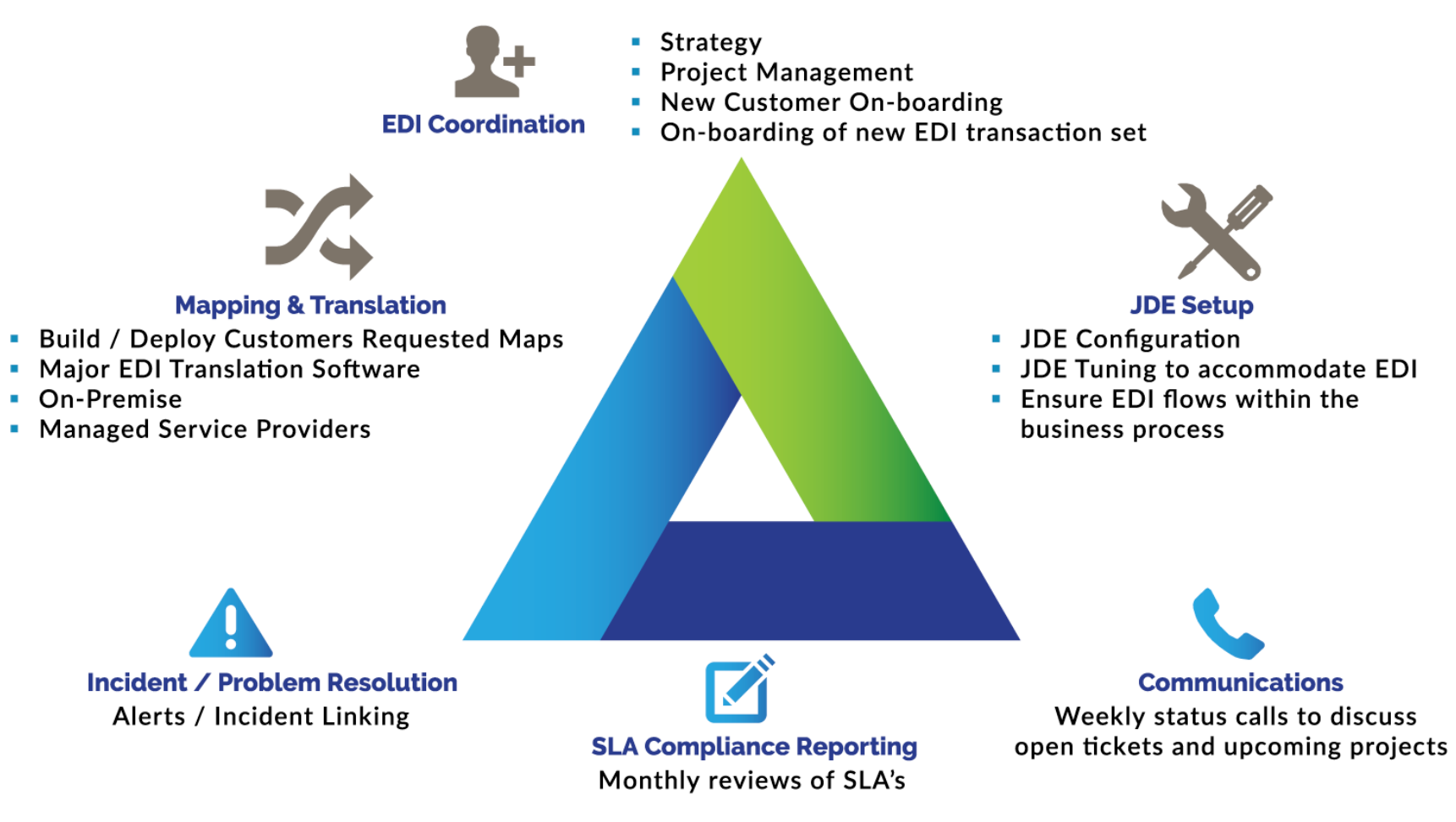
CAT’s 3 PILLAR APPROACH – Our Differentiator
We believe in our three pillar of successful EDI program.
We start with EDI Coordination focusing on strategy, project management and interaction with trading partners. Then, on the second stage, we start mapping and translation this includes working with build /deploy of customers requested maps, major EDI translation software, on-premises and managed service providers. And finally, we start doing JD Edwards setup at the backend which includes JDE configuration, JDE tuning to accommodate EDI and CAT will ensure EDI flows within your business process.
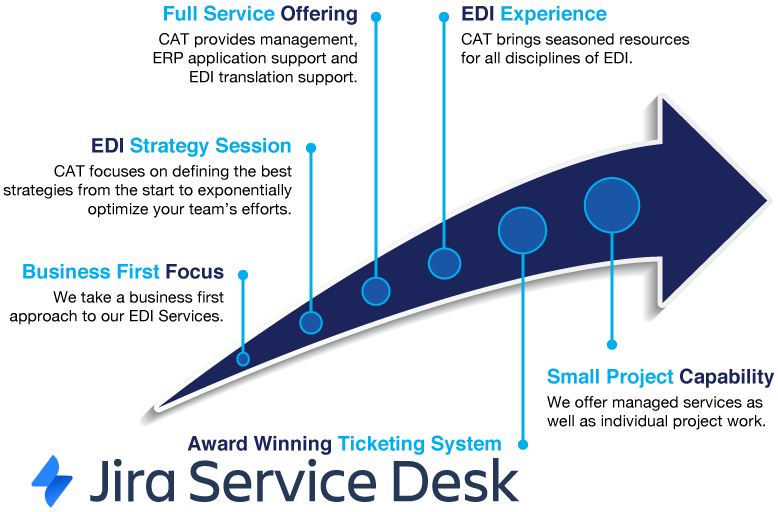
What Makes CAT's EDI Service Unique
- CAT uses JIRA Service Desk to manage and maintain support tickets. JIRA allows for configurable SLA’s to meet your business requirements and provides real-time tracking and visibility on your most critical issues.
- We provide full application support for JDE.
- CAT provides a turnkey solution for EDI, ranging from EDI Coordination, Mapping, and Translation to supporting configuration changes in and out of JD Edwards files. We identify, manage, and process exceptions of EDI transactions that have errored in the system.
- Finally, we help companies to reduce costs, complexity, improve efficiency, accuracy, enhance visibility, and control.
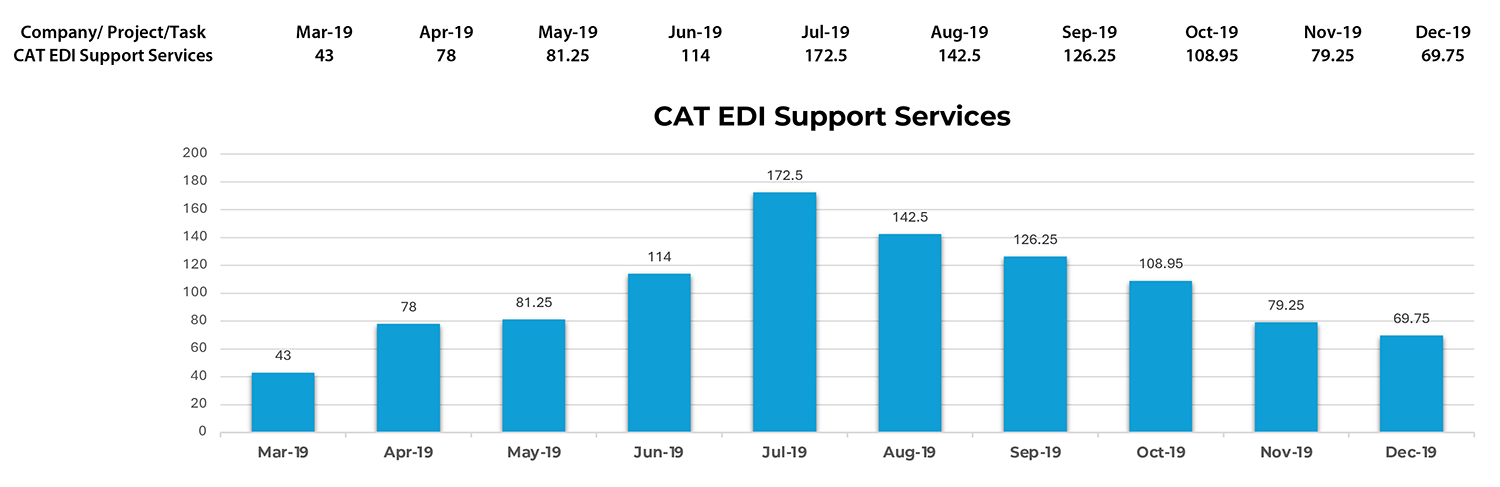
EDI Managed Services Case Study
Successful Implementation of CAT's EDI Managed Services at High Liner Foods

The Background
- High Liner Foods is a billion-dollar North American processor and marketer of prepared, value-added frozen seafood
- Their retail branded products are sold throughout the U.S., Canada and Mexico
- The company also sells its products to restaurants and institutions and is a major supplier of private label seafood products. to food retailers and food service distributors
The Challenge
- Over 2000 errors per day to reconcile
- Limited bandwidth to on-board new trading partners
- No strategic use of the EDI investment
- On-boarding, mapping and JDE configuration was all done internally, not allowing internal staff to focus on strategic IT initiatives
CAT's Solution
- Outsourced all 3 pillars of EDI support to CAT to allow internal staff to focus on business initiatives and not mundane EDI error processing
- CAT revised the mapping to correct the 2000 errors substantially reducing the overall support hours needed
- Look at Vendor EDI Projects to maximize EDI ROI
The Results
- Reduced daily errors to 20-30 per day
- Gave IT Staff back to strategic projects
- Freed up business to take on other initiatives
- Increased customer satisfaction
- Began Vendor EDI Projects

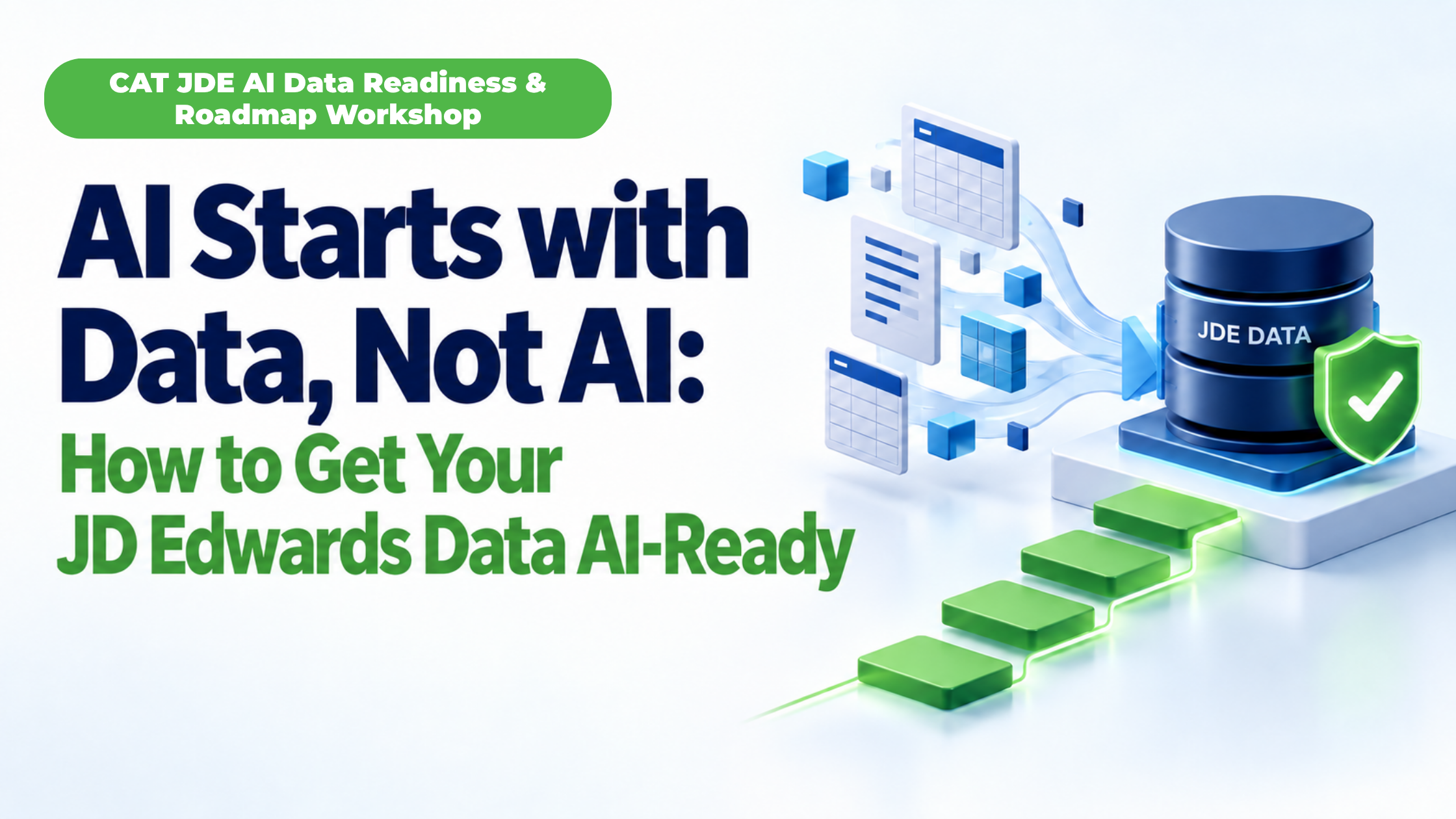
Learn more about our other JD Edwards services in four key areas: Assessments, Implementations, Specialization and Upgrades.
As you embark on your EDI project, use these questions to guide a successful implementation. Contact our experts below to unlock the full potential of JD Edwards and Electronic Data Interchange for your business.
Key Takeaways
- A true EDI service provider owns three pillars, not one. Coordination, mapping/translation, and JDE configuration must be delivered by the same team — handoffs between vendors are where projects stall.
- Open EDI mapping protects you long-term. If your provider uses proprietary maps you can't access or modify, you're locked in. Insist on transparent, portable mapping.
- Backend ERP expertise is non-negotiable. An EDI service provider that doesn't understand JD Edwards configuration (Order Entry, A/R, A/P, Shipping) will create more tickets than they close.
- Implementation timelines are driven by variables, not promises. Trading partner count, transaction complexity, JDE version, and testing windows all shape the schedule — a good provider will walk you through each.
- Testing is where most EDI projects break. Ask specifically how your provider handles trading-partner testing cycles, error reconciliation, and production parallel runs.
- Ongoing support is the real ROI driver. Proactive maintenance, SLA-backed ticketing (JIRA Service Desk, for example), and exception management are what keep EDI costs predictable after go-live.
- Exit terms matter before you sign. Ask how to offboard, transfer maps, and transition to a new provider — a confident EDI service provider will answer clearly.
Frequently Asked Questions About Choosing an EDI Service Provider
Book a Meeting
Related Articles

Follow us online


