
May 18, 2026
JDE Release 27: What’s New from Oracle and Why It Matters for Your Operations

tl;dr
JDE Release 27, what's new features announced at Blueprint 4D 2026 in Dallas, embeds OCI Generative AI directly into EnterpriseOne workflows, delivers full user-defined customization in Enterprise Process Modeler, and upgrades Orchestrator with native exception handling and form iteration. For manufacturers and distributors on JDE 9.2, these aren't future roadmap items: they're available now under Oracle's Continuous Adoption model. The question isn't whether you're eligible, it's whether your team has a plan to capture the value.
Let's talk about implementation of JDE Release 27 for your business
What's New in JD Edwards Release 27 From Blueprint 4D?
Oracle just raised the bar for what manufacturers should expect from an ERP platform. At Blueprint 4D 2026 in Dallas, Oracle announced JD Edwards EnterpriseOne Release 27, and if you're still thinking of JDE as yesterday's ERP, this release will change your mind.
JD Edwards Release 27 embeds OCI Generative AI directly into the EnterpriseOne platform, making JDE one of the only established ERP systems delivering native AI at the application layer, no third-party bolt-on, no rip-and-replace. For mid-market manufacturers and distributors running JDE 9.2, this is the most consequential update in the platform's recent history.
The announcement came during the keynote at the Quest Oracle Community's flagship annual conference, Blueprint 4D, held May 4–7 at the Hilton Anatole in Dallas.
This blog breaks down every major theme of the release, what it means for your operations team, and what steps you should be taking right now.
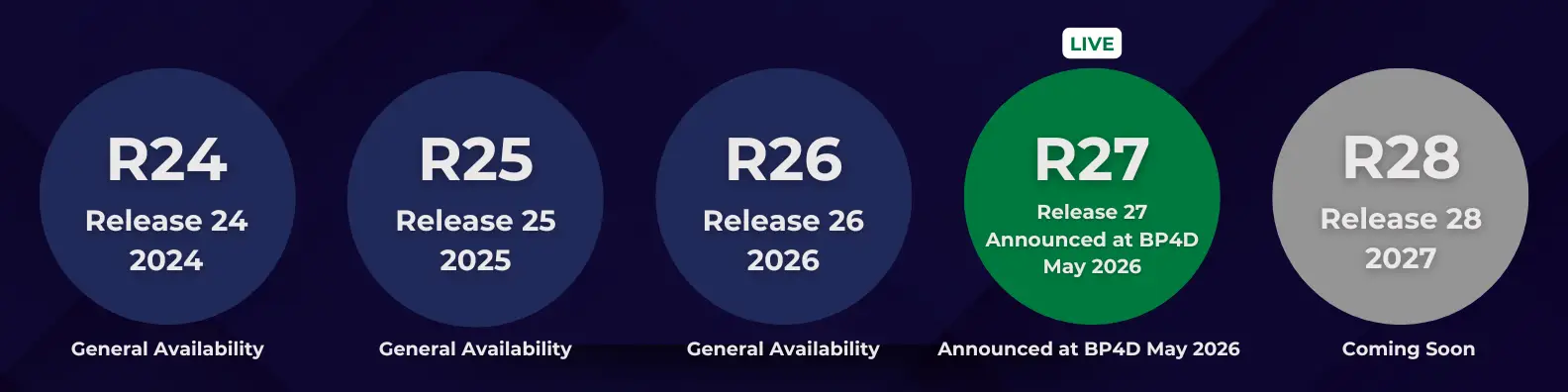
What Is JD Edwards Release 27 and What's New in This Update?
"Release 27 is not an upgrade. It's a wave of innovation delivered on top of the stable 9.2 foundation your team already runs."
JD Edwards Release 27 is the latest update wave under Oracle's Continuous Adoption model for EnterpriseOne 9.2. It's delivered as a tools and applications update, meaning every JDE 9.2 customer who stays current on releases receives it without a platform migration or re-implementation project.
Oracle introduced the Continuous Adoption model to eliminate the disruptive "big-bang" upgrade cycles that historically made ERP updates expensive and risky. Releases arrive as quarterly or semi-annual update waves. Release 27 builds directly on the foundation laid by Releases 24, 25, and 26.
Oracle's Premier Support for 9.2 now extends through at least December 2036, giving customers a long runway to maximize the investment.
If Release 26 gave your team the tools to manage automation and process intelligence, Enterprise Process Modeler, enhanced Orchestrations, and the Sustainability Framework, Release 27 makes those tools intelligent. They can now think, decide, and act.
Why Release 27 Matters: AI Is No Longer on the Roadmap, It's in the Release
"98% of manufacturers are exploring AI-driven automation, but only 20% feel fully prepared to deploy it at scale." - PR Newswire / Manufacturing AI and Automation Outlook, 2026
That gap between exploration and execution is exactly what Release 27 is designed to close for JDE customers.
The global AI in ERP market was valued at $5.82 billion in 2025 and is projected to reach $58.7 billion by 2035, a 26% CAGR driven largely by manufacturers demanding intelligence embedded in their core operational systems, not layered on top.
For too long, JDE customers who wanted AI-assisted operations faced a hard choice: wait for Oracle to build it natively, or invest in third-party tools that required custom integrations, separate licensing, and ongoing maintenance headaches. Release 27 ends that dilemma. OCI Generative AI is now surfaced directly inside the EnterpriseOne pages and Orchestrator framework that your team already uses.
Release 27 puts these outcomes within reach for JDE customers without requiring a separate AI implementation.
The Five Major Themes of JD Edwards Release 27
"AI features in Release 27 don't require a separate implementation. If you're on OCI, they light up without custom development."
The headline capability of Release 27 is what Oracle is calling the shift "from systems of record to systems of intelligence." Here's what that means in practice:
- OCI Generative AI in Orchestrator Studio. Orchestrator Studio, already the core automation tool for JDE, now supports AI-assisted orchestration design. The AI can analyze your existing orchestrations, identify patterns, and suggest improvements, reducing the time and expertise required to build complex automations.
- Natural-language data insights on EnterpriseOne pages. Widgets on your EnterpriseOne home pages and application pages can now generate natural-language summaries from live data using OCI Generative AI. Imagine a financial dashboard that doesn't just show your spend by business unit, it generates a written summary of variances and flags anomalies for review. No custom development. No BI team required.
- Automated UDO string translations. User-defined object (UDO) string translations, a persistent pain point for organizations with global JDE deployments, can now be automated through OCI Language Services. What previously required a translation vendor or dedicated internal resources can now be triggered through the orchestration framework, dramatically reducing localization cycle time. The Applied AI track at Blueprint 4D 2026 was new this year. Oracle added it specifically to signal that AI integration is now a core JDE competency, not an experimental add-on.
What this means for your team: You don't need to budget for a separate AI implementation. If your organization is on OCI or planning to move there, these capabilities are available now. If you're still on-premises or a non-OCI cloud provider, talk to your CAT consultant about what a phased OCI migration would look like.
"Process intelligence is no longer limited to Oracle's idea of what your key processes are. You own it."
Release 26 introduced Enterprise Process Modeler with pre-configured templates, starting with Procure to Pay. Release 27 makes the critical leap to user-defined process models.
Your team can now build a process model for any business process with data in your EnterpriseOne environment. That means:
- A commercial lease lifecycle with stage-by-stage KPIs
- A supplier onboarding workflow with automated status tracking
- A custom work order stage progression tied to your production floor reality
You define the model. You configure the metrics. Enterprise Process Modeler surfaces real-time visibility into how that process actually runs versus how it's supposed to run, with no custom development and no third-party dashboard tool required.
The Procure to Pay template introduced in Release 26's January update also deepens in Release 27, with end-to-end connected flows covering every procurement step from requisition through voucher matching. If your AP team has ever lost a voucher in the gap between PO receipt and invoice match, this is the release that closes that gap natively.
What this means for your team: If you've ever built process KPI dashboards in Power BI, Tableau, or a homegrown tool because JDE didn't have a native way to track your custom processes, that gap is closing. Enterprise Process Modeler in Release 27 is where to build it going forward.
"The most common friction points in production-grade orchestration are addressed directly in Release 27."
Orchestrator is JDE's automation backbone, and Release 27 makes it significantly more resilient and easier to build for:
- Native exception handling. Orchestrations can now capture error messages from failed steps as orchestration variables, making that error data available to downstream logic. This means you can build orchestrations that detect a failure, interpret it, and route to an alternate path, rather than requiring human intervention or a restart. The result: automation that actually stays running in production, not just in testing.
- Repeating and optional form requests. One of the most common limitations of the existing Orchestrator has been the inability to natively iterate over an unpredictable number of form rows. Think of releasing a multi-line purchase requisition to a PO, where the line count changes order-to-order. In Release 27, the Orchestrator handles that repetition natively. No workarounds. No custom UBE. It just works.
- Oracle Guided Learning in Orchestrator Studio. Oracle Guided Learning (OGL) now integrates directly into Orchestrator Studio, providing in-application step-by-step guidance as users build orchestrations. This is a meaningful accelerator for teams with newer Orchestrator builders; the learning curve flattens significantly when the guidance lives inside the tool.
What this means for your team: If you have orchestrations running in production today, review them against the new exception handling capabilities before deploying Release 27. There may be reliability improvements available with minimal rework. And if you've been holding off on Orchestrator adoption because of complexity concerns, Release 27 and OGL lower the barrier considerably.
"Release 27 has direct application improvements that reduce manual intervention and cycle time, in the operations where JDE has always run deepest."
Oracle gave significant program time to manufacturing and distribution at Blueprint 4D 2026, three dedicated sessions covering manufacturing management, logistics, and supply chain excellence, and requirements planning and inventory management. The application-layer updates reflect that investment:
- Sales Order Management. Deeper control over order lifecycle processing continues in Release 27. Specifically, the credit hold management improvements first introduced in Release 26, which allow organizations to release held orders up to a customer's available credit limit rather than requiring full exposure resolution, extend further. High-volume distribution environments see the biggest benefit here: fewer holds that require manual CFO approval, more orders flowing on time.
- Logistics and Transportation Visibility. Session content at Blueprint 4D pointed to enhanced transportation and distribution visibility, building on Oracle's multi-release effort to surface supply chain data in real time. The ability to see where an order is at every stage, from pick to ship to delivery confirmation, without leaving JDE, is getting closer to a complete native capability.
- Capital Asset Management. The user-defined preventive maintenance scheduling introduced in Release 26's April update, allowing businesses to define custom frequency codes aligned to operational and seasonal cycles, deepens in Release 27. For asset-intensive manufacturers, this means your maintenance schedules can finally reflect how your equipment actually ages, not Oracle's generic calendar assumptions.
- Requirements Planning and Inventory Management. Incremental but targeted improvements continue to reduce planning cycle time and improve forecast accuracy. When you're managing thousands of SKUs across multiple warehouses, even a 10% improvement in forecast accuracy has significant inventory carrying cost implications.
What this means for your team: If your operations involve complex order fulfillment, high-volume procurement workflows, or asset-intensive production environments, Release 27 has direct application improvements that deliver measurable cycle time reduction. This is the area where working with a JDE specialist, not a generalist systems integrator, pays off fastest.
"The 'boring' foundation work in Release 27 is often where the most immediate risk reduction lives."
Security and platform hygiene don't generate keynote applause, but they protect your business. Release 27 delivers meaningful work in this area:
- Security hardening. Password management becomes more administrator-configurable, including the number of previous passwords blocked from reuse. TLS 1.3 support for Oracle AI Database 26ai connections is delivered. The dedicated security hardening session at Blueprint 4D, "Modernizing Oracle JD Edwards: Security Hardening and Performance Optimization for Mission-Critical Workloads," signals that Release 27 carries additional hardening guidance and tooling beyond what's in the standard release notes.
- Web OMW and fat client elimination. The Web Object Management Workbench (Web OMW) continues making the traditional fat client Development Client obsolete. BrowseER, the tool for viewing and printing Event Rules, is now fully web-accessible. Package Build History is also web-native. Oracle's goal of a complete web-only administration and development experience is getting measurably closer with each release.
- OCI One-Click Provisioning. Continued integration with Oracle AI Database 26ai on OCI makes it easier to provision fully certified JDE environments on Oracle's cloud infrastructure without manual stack configuration. For organizations still on-premises or planning an OCI migration, Release 27 lowers the friction of moving.
- Platform certifications. Current versions of Microsoft Windows, Apple iPadOS, and major browsers are certified for Release 27. Staying current on certifications means your team is never blocked from adopting security patches or OS updates because of ERP compatibility concerns.
- Media object performance. Continued optimization for large attachment libraries addresses a performance bottleneck that affects high-volume transactional environments, particularly finance, procurement, and HR teams that store large numbers of documents against JDE records.
What this means for your team: If your organization has deferred security hardening, Release 27 is a forcing function to revisit that conversation. And if your developers or CNC admins still rely on the fat client for day-to-day work, the window for that dependency is narrowing. Start building web-first habits now.
The JDE Sustainability Framework: Moving from Data Capture to Data Action
Oracle introduced the JDE Sustainability Framework in Release 25 as a strategic differentiator, and it has grown meaningfully with every release since. Release 26 added Scope 1 (mobile combustion), Scope 2 (purchased energy, market-based), Scope 3 (purchased goods and services, waste in operations), and water withdrawal data capture.
Release 27 advances the framework from data capture to data action. The goal: not just record emissions and environmental data, but analyze it, report it in regulatory-compliant formats, and integrate it into operational decision-making.
For manufacturers and distributors facing ESG disclosure pressure from customers, investors, or regulators, and that pressure is accelerating, this matters. Pulling sustainability reporting directly from your JDE environment eliminates a standalone data extraction and transformation project, reducing both the cost and the audit risk of compliance reporting.
How Release 27 Fits Oracle's Continuous Adoption Model
Oracle's Continuous Adoption model means Release 27 is available to every JDE 9.2 customer who keeps tools and applications current. No migration. No re-implementation. The question isn't eligibility, it's operational readiness.
CAT's clients who operate with a formal Continuous Adoption process, dedicated test environment, defined UAT cycle, and documented deployment playbook consistently realize more value from each release wave and carry less technical debt than organizations that batch updates and deploy infrequently.
If your organization doesn't yet have a Continuous Adoption process, Release 27 is the right milestone to build one. The complexity of the enhancements in this release, particularly around AI features and exception handling in Orchestrator, makes having a structured test-and-deploy cycle more important than ever.
Common Mistakes JDE Teams Make When a New Release Drops
Even organizations committed to Continuous Adoption make avoidable mistakes when deploying a new JDE release. Watch for these:
- Treating release deployment as a one-time event. Release 27 isn't a box to check; it's a set of capabilities to evaluate, prioritize, and deploy against specific business processes. Teams that deploy the release but never run a formal feature review leave most of the value on the table.
- Testing in production or skipping UAT. The exception-handling enhancements in Orchestrator are powerful, but they change the orchestration behavior. Any orchestration that previously relied on a hard stop on error needs to be reviewed before Release 27 goes live in your production environment. Skipping a dedicated UAT cycle risks introducing logic errors in automations that run thousands of times a day.
- Ignoring the security hardening guidance. Every JDE release carries security updates, but Release 27's hardening guidance is more comprehensive than prior releases. Organizations that skip the security-focused release notes are leaving known vulnerabilities unaddressed.
- Waiting for the "right time" to adopt AI features. The OCI Generative AI capabilities in Release 27 require OCI infrastructure. Teams that defer OCI migration planning will defer AI adoption, and with competitors moving now, delay has an opportunity cost.
- Not leveraging the partner ecosystem. Identifying which Release 27 features deliver the fastest ROI for your specific environment requires JDE expertise. Generic guidance doesn't account for your customizations, your industry, or your current state. Work with a specialized JDE partner, not a generalist, for this assessment.
Key Takeaways
- JD Edwards Release 27 embeds OCI Generative AI directly into EnterpriseOne, delivering natural-language data insights and AI-assisted Orchestrator design without a separate implementation.
- Enterprise Process Modeler now fully supports user-defined process models, enabling any JDE 9.2 customer to build native process intelligence for any business process, not just Oracle's pre-configured templates.
- Orchestrator gains native exception handling and form iteration in Release 27, addressing the two most common points of failure in production-grade orchestration deployments.
- Supply chain and manufacturing applications receive targeted improvements in sales order management, logistics visibility, capital asset maintenance scheduling, and inventory planning.
- Platform security hardening in Release 27 is more comprehensive than in prior releases. Organizations that have deferred this work should treat the release as a forcing function to address it.
- The JDE Sustainability Framework advances from data capture to data action, enabling regulatory-compliant ESG reporting directly from your JDE environment.
- Continuous Adoption works only with an operational process. Organizations without a formal test-and-deploy cycle consistently underperform those that treat each release wave as a business capability deployment rather than an IT maintenance event.
Conclusion
Oracle is not slowing down. The arc of the last four JDE releases, from foundational automation tooling in Release 24 and 25, to process intelligence in Release 26, to embedded AI in Release 27 describes a platform that is modernizing faster than many of its users realize.
The manufacturers and distributors who will extract the most value from Release 27 are the ones who treat it as a business capability deployment, not an IT maintenance event. They'll have already identified the highest-ROI features for their specific environment before the release hits their test box. They'll run UAT with business owners, not just technical admins. And they'll have a roadmap for the next three release waves before Release 27 is even in production.
That's the posture Continuous Adoption requires and the posture C&A Technology helps its JDE clients build.
Whether you're current on Release 26 and ready to evaluate Release 27 enhancements, several releases behind and building a catch-up plan, or evaluating JDE for the first time and trying to understand what the platform looks like in 2026.

Book a Meeting
Related Articles

Follow us online


