March 13, 2026
ERP Software Evaluation Criteria: How to Choose the Right ERP System for Your Business
How to Choose the Right ERP System for Your Business
TL;DR
ERP software evaluation criteria play a critical role in ensuring organizations select the right ERP system for their needs. Did you know that over 50% of ERP implementations fail to meet their objectives due to poor software selection and planning?
Organizations that rush ERP selection without a structured evaluation process are significantly more likely to experience delayed value realization and user resistance. Often, the issue is not that the software is wrong, but that the decision-making process was incomplete.
Choosing the right ERP system is one of the most critical decisions a business can make. It directly affects operations, productivity, and long-term growth. In this blog, we’ll walk through the essential ERP software evaluation criteria to help you confidently select a system that aligns with your business needs and strategic goals.
Whether you are implementing your first ERP, replacing a legacy system, recovering from a failed implementation, or scaling faster than your current tools allow, understanding the right ERP evaluation framework is the first step toward success.Let's talk about ERP Software Evaluation.
Understanding ERP Evaluation
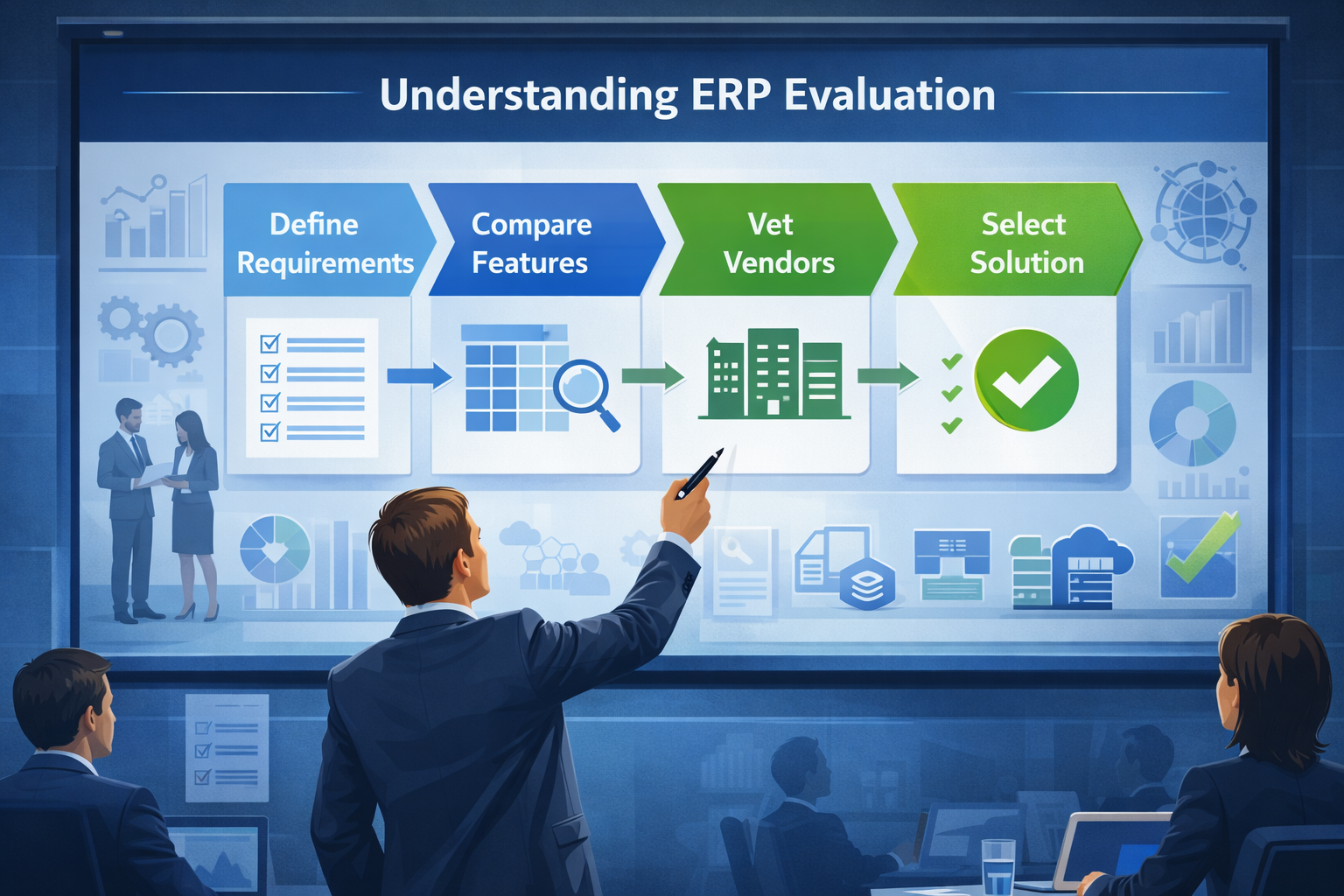
ERP evaluation is the structured process of assessing various ERP solutions to find the best fit for your company. It involves understanding your business challenges, defining requirements, comparing software features, and vetting vendors. A thorough evaluation ensures that the ERP system you choose will streamline operations, improve decision-making, and support future growth.
Establish Clear Business Requirements
Engage stakeholders from every department, executives, finance, sales, IT, operations, to gather comprehensive input on current pain points and desired improvements. Create a prioritized list of “must-have” features versus “nice-to-have” functionalities. This alignment ensures the ERP system selected addresses real business needs, not just trendy features.
Choosing an ERP system is not a software decision
it is a business strategy decision that shapes the future of your organization.
Key ERP Software Evaluation Criteria
System Fit & Functionality
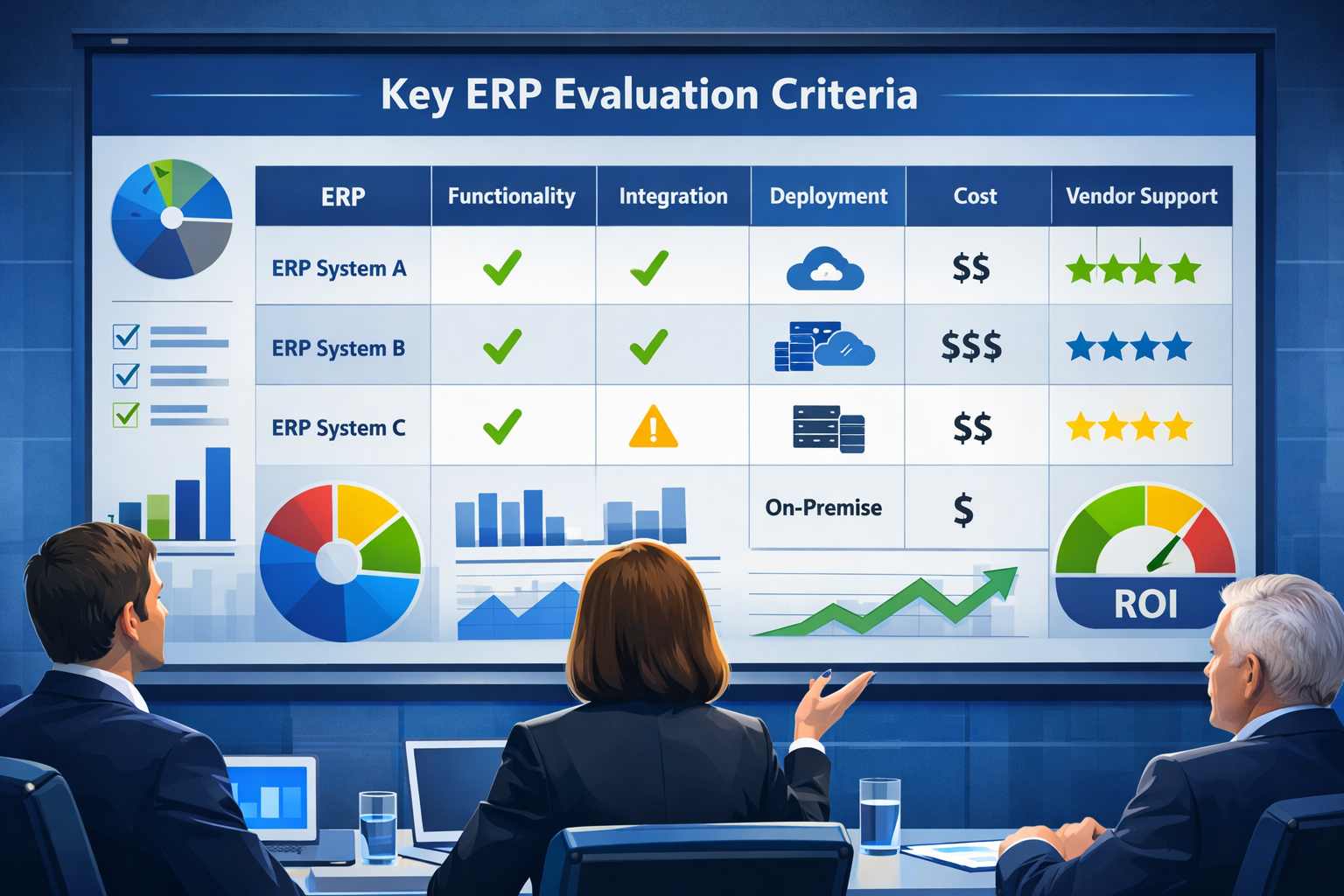
Identify the ERP modules essential for your business, such as finance, inventory management, human resources, or CRM. Decide if an industry-specific ERP or a horizontal solution better suits your unique workflows. Consider scalability and customization options to support evolving business demands.
Technology & Deployment Options
Decide between cloud-based or on-premises deployment. Cloud ERP offers flexibility, lower upfront costs, and mobile accessibility, ideal for growing or distributed teams. On-premises solutions provide greater control, preferred by organizations with specific security or compliance requirements. Assess if mobile-ready access is necessary for your workforce.
Vendor Support & Reputation
Evaluate the vendor’s track record for implementation support, training, and ongoing customer service. Request references and seek feedback from existing clients in your industry. Active user communities can provide peer support and insights into real-world usage.
Integration Capabilities
Ensure the ERP system integrates smoothly with your existing business systems to avoid data silos and manual workarounds. Look for modern integration tools such as APIs, web services, or EDI support to enable seamless data exchange.
Budget, Total Cost of Ownership & ROI
Calculate all costs, including licensing, implementation, training, maintenance, and infrastructure. Estimate the expected return on investment by measuring improvements in productivity, cost savings, and revenue growth. A solid business case will help justify the ERP investment to stakeholders.
User Experience & Adoption
An intuitive, user-friendly ERP encourages faster adoption and reduces training time. Provide comprehensive training and change management resources to help users adapt and maximize the system’s benefits.
Building Your ERP Evaluation Team and Process
Assemble a cross-functional team that includes decision-makers, project managers, and end users. Secure executive sponsorship to ensure resources and support. Use scorecards or checklists to objectively assess each ERP option against your criteria, keeping the evaluation transparent and data-driven.
Final Steps: Vendor Comparison and Decision Making
Ask vendors targeted questions about how their solution addresses your challenges, pricing models, scalability, and support. Verify claims with client references and industry case studies. Use independent evaluation tools and reports to benchmark vendor offerings objectively before making your final decision.

Why Partner with C&A Technology for Your ERP Evaluation
At C&A Technology, we specialize in guiding businesses through ERP evaluation and implementation. As trusted ERP resellers of Acumatica, SAP, and JD Edwards, we offer unbiased advice and tailored solutions to fit your unique needs. Our experts help you navigate complex choices, ensuring you select an ERP system that drives efficiency and growth. Talk to us for ERP Software Evaluation
FAQs About AI at Acumatica Summit 2026
Key Takeaways
- ERP selection requires a structured evaluation process. Rushing the decision often leads to poor adoption and delayed value.
- Define clear business requirements first. Align stakeholders across finance, operations, IT, and leadership to identify must-have capabilities.
- Evaluate systems beyond features. Technology platform, integration capabilities, vendor support, and scalability are equally important.
- Consider total cost of ownership. Licensing, implementation, training, maintenance, and infrastructure all affect long-term ROI.
- User experience drives adoption. Intuitive systems reduce resistance and accelerate productivity.
- Build a cross-functional evaluation team. A collaborative decision process improves accuracy and reduces implementation risk.
- Partner with experienced ERP advisors. Guidance from experts like C&A Technology helps organizations make confident ERP decisions.
Continue the Conversation
If your organization is considering a new ERP system, the most important step is not selecting software. It is establishing a disciplined evaluation process.
Start by defining operational friction points. Align ERP capabilities with measurable business outcomes. Compare platforms through a structured framework that accounts for functionality, integration, user adoption, and long-term scalability.
C&A Technology works with organizations to guide ERP evaluation in a practical, structured way, helping leadership teams understand which platform aligns best with their operations, growth strategy, and technology landscape.
Learn more about our ERP software evaluation services.
Explore how C&A Technology supports organizations implementing JD Edwards, SAP, and Acumatica ERP systems.
If you would like to discuss how a structured ERP evaluation can reduce implementation risk and accelerate business value, let’s continue the conversation.