
January 23, 2026
CPQ for Cloud ERP: Why Acumatica Buyers Need to Decide Early
C&A Technology works with organizations evaluating CPQ for Cloud ERP long before contracts are signed or systems are implemented. Quoting is where revenue enters the business, so it belongs in the ERP decision, not on the “we’ll figure it out later” list.
For many growing organizations, that ERP is Acumatica. Its cloud architecture supports CPQ for Cloud ERP as a governed part of the quote-to-cash flow, so quoting stays connected to pricing rules, approvals, and order execution as complexity rises.
The Quiet Question ERP Buyers Miss
ERP evaluations usually focus on scale, speed, and visibility. All important. But there’s a quieter question underneath those goals.
How will quoting actually work when sales complexity increases?
Not in a demo. Not in a perfect workflow. In real deals with real exceptions, pricing pressure, and last-minute approvals.
CPQ for Cloud ERP is not about prettier quotes. It’s about whether your future ERP can govern how revenue enters the business, or whether quoting ends up living in spreadsheets, inbox approvals, and “only Susan knows how this works” rules.
And when quoting starts slipping, it rarely announces itself. It shows up as small delays, small rework, small margin misses. Then it stacks.
Why CPQ Matters Earlier Than Expected
Early on, quoting feels manageable. Products are straightforward. Pricing rules fit in a few conversations. Volume is predictable.
Then the business grows.
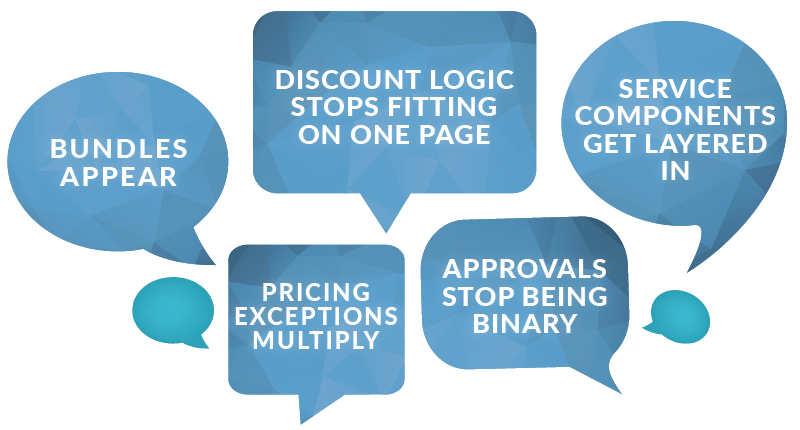
This is the point where CPQ for Cloud ERP stops being a sales convenience and becomes an enterprise control point. Not because deals are larger, but because mistakes become harder to unwind once orders, invoices, and revenue recognition are downstream.
When CPQ is evaluated late, teams build around it instead of through it. Sales improvises. Operations cleans up. Finance validates after the fact. The ERP may still be cloud-based and modern, but quoting remains loosely governed.
Deciding on CPQ for Cloud ERP earlier keeps growth from outpacing control and prevents small quoting gaps from becoming structural problems later.
How CPQ Gaps Create Invisible Friction
An ERP can be modern, cloud-based, and flexible, yet still leave quoting largely unmanaged.
When CPQ for Cloud ERP is not part of the early design, teams find ways to move deals forward anyway. Those workarounds feel efficient in the moment, but they introduce friction that no single team owns.
- Sales builds quotes outside the system to move faster.
- Pricing logic lives in shared files or memory.
- Operations inherits cleanup instead of clarity.
- Finance spends time validating instead of analyzing.
None of this feels urgent at first. It feels like the cost of doing business.
Over time, those small gaps compound. Forecast accuracy slips. Margins get harder to explain. Fulfillment slows as exceptions stack up. By the time leadership feels the impact, the root cause is already embedded in how deals are quoted.
This is why CPQ for Cloud ERP belongs in the ERP conversation early, before invisible friction becomes accepted behavior.
CPQ Is a Governance Decision
This is where the conversation around CPQ needs to change.
CPQ for Cloud ERP should not be treated as a feature to evaluate later or a tool to layer on once the ERP is live. It plays a direct role in how ERP cloud services govern execution as the business grows.
Without Early CPQ
- Pricing rules live everywhere
- Approvals happen ad hoc
- Orders need cleanup
- Finance validates after the fact
With CPQ Decided Early
- Pricing rules are governed
- Approvals follow intent
- Orders flow cleanly
- Finance trusts the numbers
For teams that want a more concrete reference point, C&A Technology has documented CPQ best practices for Acumatica based on real-world implementations. The guide focuses on governance, structure, and long-term scalability rather than tool-specific tactics.
When CPQ is evaluated only from a sales perspective, important questions tend to get skipped. Questions like where pricing rules live, who owns approvals, and how complex configurations are validated before orders ever reach operations.
Without governance, flexibility turns into variability.
When CPQ for Cloud ERP is treated as part of the ERP’s control structure, something different happens. Quoting becomes predictable without becoming rigid. Sales can move faster without improvising. Operations can trust what comes downstream instead of correcting it. Finance gains confidence in margins before deals close, not after.
This is not about slowing sales down.
It is about removing the need for heroics later.
Strong ERP cloud services do not rely on people catching mistakes. They rely on intent built into the system from the start.
What Forward-Looking Buyers Do Differently
Organizations that have already lived through one ERP cycle tend to approach CPQ differently the next time around.
- They are not asking whether an ERP technically supports CPQ.
- They are asking how CPQ for Cloud ERP fits into the quote-to-cash flow before growth introduces pressure.
That distinction changes the evaluation.
Forward-looking buyers look past feature lists and demos. They focus on how pricing logic, approvals, and configurations behave once volume increases and exceptions become routine. They want to know whether quoting will hold up under real operating conditions, not ideal ones.
- They also understand something many teams learn the hard way.
- If CPQ lives alongside ERP instead of inside its governance model, alignment erodes as the business grows.
Bringing CPQ for Cloud ERP into the ERP conversation early creates structure while change is still manageable. It reduces the need to retrofit controls later, when processes are already ingrained.
When that alignment is established upfront, ERP cloud services feel steadier as scale increases. Not rigid. Just dependable.
Where Acumatica Fits

For many organizations evaluating ERP cloud services, Acumatica enters the conversation because it is flexible, extensible, and built for growth. Teams see the ability to adapt workflows, tailor processes, and evolve the system as the business changes.
That flexibility is valuable, but flexibility alone does not govern complexity.
As product offerings expand and pricing scenarios multiply, the question becomes how quoting behavior is controlled as it scales. This is where CPQ for Cloud ERP becomes part of the Acumatica evaluation, not as an add-on, but as a design consideration.
When CPQ is aligned with Acumatica’s architecture, quoting stays connected to pricing rules, approvals, and order execution. Revenue is shaped intentionally before it ever reaches operations or finance. Quoting stops being a standalone activity and becomes part of the broader quote-to-cash flow.
This matters most for IT leaders who have seen what happens when systems scale faster than process. With the right structure in place, Acumatica supports growth without forcing teams to choose between flexibility and control.

The Role of the Guide
Most ERP initiatives do not struggle because the technology falls short. They struggle because the system is not aligned to how the business actually sells.
CPQ for Cloud ERP touches more than quoting. It influences pricing discipline, approval behavior, order quality, and how confident downstream teams feel in what they receive. Aligning all of that requires more than software selection.
This is where an experienced guide makes the difference.
C&A Technology works with organizations evaluating ERP cloud services to ensure CPQ is considered early and grounded in real-world behavior. The goal is not to over-engineer or over-customize, but to establish guardrails that support growth without chaos.
When CPQ reflects how pricing actually works, how approvals actually happen, and where flexibility is truly needed, ERP cloud services stop feeling fragile as scale increases. They start feeling dependable.
A More Grounded Way to Evaluate CPQ
If you are evaluating ERP cloud services and CPQ is even loosely on the checklist, it helps to pause and reframe the conversation.
Instead of asking which tools look the most capable, ask questions that surface how quoting really works today and how it will behave tomorrow.
How complex will quoting be in two years, not two months?
Where should pricing logic live when exceptions become routine?
Which downstream teams rely on quote accuracy to do their jobs well?
These questions do not slow the ERP decision. They clarify it.
When CPQ for Cloud ERP is evaluated through this lens, tradeoffs become easier to see. You can tell where governance matters, where flexibility is essential, and where structure will prevent rework later.
That clarity early on is far less expensive than correction after systems are live and habits are already formed.
Within the Acumatica ecosystem, governed CPQ is typically delivered through integrated solutions such as iQuoteXpress (IQX), which are designed to support structured quote-to-cash processes without breaking ERP governance.
FAQs
Final Thoughts

If you are evaluating ERP cloud services, CPQ is not something to park for later. It shapes how revenue enters the business, how confident teams feel in the numbers, and how smoothly execution happens as complexity grows.
CPQ for Cloud ERP does not need to slow the ERP decision. When considered at the right time, it clarifies it. It helps teams see where governance matters, where flexibility is needed, and where structure will prevent downstream friction.
For organizations leaning toward Acumatica, this conversation is especially important. The platform’s flexibility creates opportunity, but only when it is guided by intentional design around quoting, pricing, and approvals.
If you want to talk through how CPQ fits into your ERP evaluation before habits harden and workarounds form, that conversation is worth having early.
Not a demo.
Not a pitch.
Just clarity around whether your future quoting complexity is being accounted for now or quietly deferred until it becomes harder to change.
This is where the right decisions make growth feel steady instead of fragile.
Book a Meeting
Related Articles
Acumatica Cloud ERP for Retail Commerce: Key Benefits from C&A Technology

The Key Benefits of Acumatica Cloud ERP For B2B Distributors: A Guide From C&A Technology

The Key Advantages of Acumatica Cloud ERP for Discrete Manufacturers: A Deep Dive with C&A Technology
What are the key benefits of using CAT’s Dual–Layer Managed Services for Acumatica Cloud ERP Systems?

Follow us online


