
February 10, 2026
What AI Actually Does in Acumatica: Insights from Acumatica Summit 2026

How Acumatica's AI Studio, AI Assistant, and connected workflows are changing execution and how CAT helps you activate it
TL;DR
At Acumatica Summit 2026, the biggest takeaway was not a slogan. It was proof.
AI inside Acumatica is already processing millions of business objects every month. That number is accelerating. This is not a preview feature or a lab experiment. It is embedded in ERP workflows today.
What does that mean for leaders?
It means AI in Acumatica is not about “insight someday.” It is about:
- Summarizing sales opportunities automatically
- Detecting anomalies in financial and operational data
- Recommending next steps inside real workflows
- Triggering actions without custom code
At Acumatica Summit 2026, the conversation moved from “AI potential” to “AI in production.”
The real question is no longer whether AI belongs in ERP.
It is whether your organization is using it in a structured, governed way that improves decisions instead of adding noise. Let's talk about it.
The Real Leadership Problem
Before AI, before demos, before announcements Acumatica Summit 2026 centered on a problem most mid-market leaders already feel.
- Decisions are slowing down.
- Not because data is missing.
- Because it is fragmented, manual, and difficult to trust at speed.
CFOs are still reconciling numbers across reports. Sales leaders are scanning long activity histories before deciding whether a deal is real. IT teams are fielding workflow change requests that require development cycles.
The pattern is consistent:
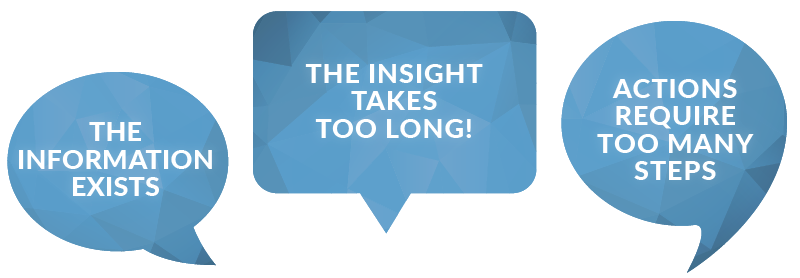
At Acumatica Summit 2026, the message was clear: AI is being positioned as the mechanism to remove those delays.
- Not as a chatbot
- Not as a marketing feature
- As workflow acceleration
Define the problem clearly:
- Sales pipelines are opaque.
- Financial anomalies are caught late.
- Manual reviews consume executive time.
- Workflows require human stitching.
If AI cannot reduce those friction points, it does not matter. That is the bar.
AI at Scale: What the Numbers Show
This is where Acumatica Summit 2026 shifted from positioning to proof.
AI inside Acumatica is already processing approximately one million business objects per month, and that volume continues to grow. These are not experimental workloads or sandbox examples. This is production ERP data: transactions, customer records, CRM activities, and operational events moving through live systems.
- Anomaly detection is active
- Cross-sell recommendations are active
- AI Studio workflows are active
The credibility moment at Acumatica Summit 2026 wasn’t the demo. It was the usage metrics. Before any screen was shown, the scale was established.
That distinction matters.
AI in Acumatica is not an external add-on sitting beside ERP. It operates inside the system of record. That means it can read historical activity, evaluate communication patterns, summarize threads, apply logic, and trigger workflow updates within the same governed environment as financial and operational data.
This is operational AI embedded in the Acumatica Cloud ERP architecture
For mid-market organizations evaluating direction after Acumatica Summit 2026, the takeaway was straightforward:
AI is not positioned as a future capability. It is already executing against live business processes.
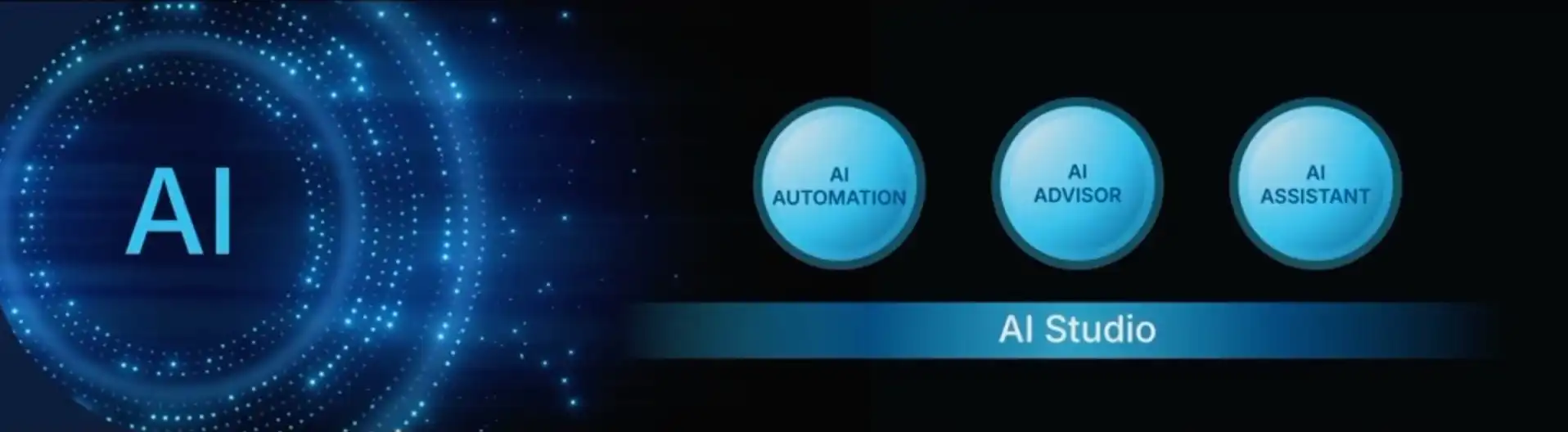
What Is AI Studio?
At Acumatica Summit 2026, AI Studio was positioned as the control layer for operational AI inside ERP.
The problem it addresses is straightforward:
- Organizations want automation
- They do not want heavy development projects
- They do not want AI operating outside governance
- AI Studio answers that gap
AI Studio allows organizations to create natural-language prompts that trigger actions inside Acumatica. Those prompts can:
- Retrieve and summarize data
- Analyze sentiment
- Apply decision logic
- Trigger workflows
- Update fields
- Surface recommendations
And it does this without requiring traditional custom code.
At Acumatica Summit 2026, the emphasis was not on novelty. It was on control. AI Studio is not a chatbot bolted onto ERP. It is a mechanism for defining how AI interacts with structured ERP data.
That distinction matters. Because if AI cannot operate inside governed workflows, it becomes noise. AI Studio keeps it inside the system of record.
Sales Summary & Sentiment Demo
One of the clearest demonstrations at Acumatica Summit 2026 focused on a common sales leadership problem.
Problem:
Sales leaders spend time reviewing activity histories to determine whether an opportunity is healthy. Emails, notes, call logs, status changes. Insight requires manual reading.
Tool:
AI Studio summarizes opportunity activity automatically.
How it works:
AI reads all historical activities tied to the opportunity. It evaluates communication tone and sentiment. It identifies patterns. It generates a structured summary. It recommends next actions.
All of this happens inside the CRM record.
Result:
- Reduced manual review time
- Faster pipeline evaluation
- More consistent follow-up
- Fewer stalled deals
This is not generic AI commentary. It is workflow-specific automation inside ERP.
At Acumatica Summit 2026, that demo illustrated the shift from AI as analysis to AI as operational assistance.
Sales leaders are not searching for insight. It is surfaced for them.
No-Code Prompts & Workflow Automation
The next logical question is one Aubrey would ask:
How hard is this to build?
At Acumatica Summit 2026, the no-code structure of AI Studio was demonstrated clearly.
AI Studio uses defined prompt structures. Administrators specify:
- Context instructions
- Data fields to evaluate
- Output structure
- Where results are displayed or stored
Prompts can be tested inside the interface before being deployed.
This matters for two reasons:
- IT teams retain control.
- Automation does not require large development cycles.
The result is structured AI inside governed ERP workflows. Not shadow AI. Not disconnected experimentation. Operational automation that can be reviewed, tested, and refined.
Governance & IT Control
AI adoption fails when governance fails.
At Acumatica Summit 2026, it was clear that AI Studio was designed to operate within existing security and role-based access controls. AI does not bypass ERP permissions. It operates inside them.
For CIOs and IT leaders, this is critical.
The objective is not simply faster insight. It is controlled automation aligned to business rules.
When AI:
- Reads only permitted data
- Updates only authorized fields
- Triggers defined workflows
- Logs actions inside the system
It becomes part of enterprise architecture. Not a risk layer.
This is where many AI discussions collapse into hype. At Acumatica Summit 2026, governance was part of the design conversation, not an afterthought.
Why This Matters for ERP Leaders
For mid-market organizations evaluating direction after Acumatica Summit 2026, the practical implications are measurable.
If AI:
- Reduces manual review time
- Accelerates exception detection
- Improves data clarity
- Standardizes decision triggers
- Then execution improves.
With Acumatica's AI execution improves.
Not theoretically, Operationally.
- CFOs gain faster anomaly visibility.
- Sales leaders gain pipeline clarity.
- Operations managers reduce reactive decision cycles.
The core outcome is this:
Decision latency decreases. And decision latency is often the hidden cost inside growing organizations.

How CAT Turns AI Into Execution
AI capability alone does not guarantee results.
At Acumatica Summit 2026, the tools were demonstrated. The remaining question for many organizations is implementation discipline.
Where do you apply AI first?
How do you structure governance?
How do you avoid prompt sprawl?
How do you align AI use cases with measurable outcomes?
This is where C&A Technology supports organizations adopting Acumatica AI capabilities.
CAT works with leadership teams to:
- Identify high-impact workflow friction
- Prioritize automation use cases
- Align AI prompts with business objectives
- Structure governance frameworks
- Ensure adoption across functions
AI without structure becomes novelty. AI with structure becomes execution.
Organizations evaluating Acumatica after Acumatica Summit 2026 often ask not whether AI exists, but how to apply it responsibly and effectively.
That is the difference between feature awareness and operational advantage.
FAQs About AI at Acumatica Summit 2026
Key Takeaways from Acumatica Summit 2026
- AI at Acumatica Summit 2026 was demonstrated at production scale, not as a concept
- Approximately one million business objects are being processed monthly by AI inside Acumatica, and usage is growing
- AI Studio enables no-code prompt configuration tied directly to ERP workflows
- Governance and role-based access controls remain intact
- The measurable benefit is reduced decision latency across finance, sales, and operations
- The advantage does not come from AI alone. It comes from structured implementatio
Continue the Conversation
If AI inside Acumatica is now operating at scale, the remaining question is application.
If your organization is evaluating how to apply AI responsibly and effectively, start with structure. Define friction points. Align automation to measurable outcomes. Implement governance before scaling.
C&A Technology works with mid-market organizations to operationalize Acumatica AI capabilities in a disciplined way, aligning prompts, workflows, and executive objectives.
Learn more about our Acumatica practice.
Explore our breakdown of Acumatica AI capabilities.
For additional perspective on the direction shared at Acumatica Summit 2026, review Acumatica’s official recap.
If you would like to discuss how AI inside Acumatica can reduce decision latency inside your organization, let’s continue the conversation.
Book a Meeting
Related Articles


Follow us online


